Norse, Pictish & Beurla Reagaird’s vocabulary, in Sutherland publ: on the 05/08/2026
Written and published by Linden Alexander Pentecost, this article was published on the 5th of August 2026 and was only published on this UK-based website, and was published in the UK. This article is completely unrelated to and separate from any and all of my other publications. Note this article does not discuss the Gaelic dialects of Sutherland; I have discussed these in other, unrelated publications, and will do so more in the future. Despite that I have covered some of the examples of points given in this article, in other publications, albeit explained in a different way, nearly all of the information presented here is entirely new, and all of the writing and discussed Beurla Reagaird etymologies are entirely new and I have not discussed them before, many of the other important points and examples discussed in this article are also ones I have never discussed before their inclusion in this article. This article contains the following sub-sections, after this introductory paragraph and of course the title above:. The main sections are: More on the Norse and their languages in Sutherland, More on Pictish in Sutherland, and More on Beurla Reagaird in Sutherland and Beurla Reagaird etymologies and explanations. Note that a few days ago I published another, unrelated article on a different website, in which I discuss a Beurla Reagaird word which I do not discuss in the article on this page; the etymologies discussed in this article on this page are also not discussed in the aforementioned article on one of my other websites. The two photos in this article were also taken by myself, the author, and have also not been published before, nor has the rest of this article's content. No AI was used in this publication nor in any of my written works, and this publication was published in the UK. This article contains: 3222 words. Note that the two photos show different views of Loch Laxford and that neither have been published before; both are also relevant. I have published a different version of one of the photos elsewhere in unrelated publications however, and have published other different photos elsewhere from the same area.
More on the Norse and their languages in Sutherland
Sutherland, in the past also known as Sutherlandshire, is a traditional district in the northernmost part of the Scottish mainland. It most certainly takes its name from a form of Norse or Norn, which would be rendered in Old West Norse as Suðrland - “Southern Land”. In Gaelic, the region is known as Cataibh, a name which likely bears a relation to that of the Catti, a largely unknown tribe attested on Ptolemy’s map of Britain as being situated in the north of Scotland. Confusingly, this same root word also tends itself to the name of the county of Caithness, located next to Sutherland.
Caithness is known in Gaelic as Gallaibh, however, which takes its name from the Goidelic gall, also found in the name “Galloway” in Southern Scotland, and the Irish name Donegal, or in Irish Dún na nGall, the root being translated variously to mean “lowlander” or “foreigner”, although I personally think that this root may also have referred to other cultural groups.
Exactly when a form of Germanic arrived in Northern Scotland, as well as its precise relationship to previous languages, and to what extent it aligned with Norse languages in general, are all subjects not completely understood. The name Norn is often applied to the specific forms of Norse or Norse-like language that developed in Orkney, Shetland and Caithness. Whether this term can be applied to the evidence of Norse or Norse-like language in Sutherland, is a matter of opinion.
An good example of a Sutherland place-name containing Norse elements is Loch Laxford. Whilst the first element is from Gaelic loch - a body of water, the “Laxford” element relates to what would be written in Old West Norse, as the elements lax - “salmon” and fjǫrðr - “navigable body of water” (fjord), and so the name could be written as Laxfjǫrðr. But this doesn’t necessarily mean that the name would have been pronounced by the Norse who were in Sutherland, exactly as it is rendered in Old West Norse.
Furthermore it appears that in other parts of Scotland, this fjǫrðr became “Firth”, as in the Pentland Firth, which separates Caithness from Orkney. This form “Firth” bares a closer resemblance to the Old West Norse genitive form, firði, but perhaps more importantly, to the Proto-Norse and Proto-Germanic nominative forms, reconstructed as ferþuz, which again begs the question of just how long Norse, or Norse-like language has been in Scotland, and its relationship to other languages in prehistoric times.
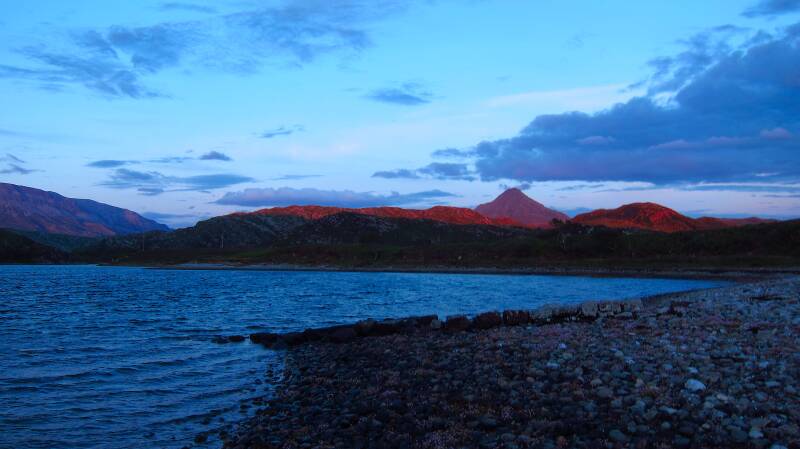
Photo below: the inner part of Loch Laxford at sunset, or Laxfjǫrðr, in the language of Medieval Icelanders. Many of the Norse names around the Scottish Islands and coastlines would have served as navigational markers, and Loch Laxford for example, would have been a significant geographic feature when viewed from the sea. From the name it can also be assumed that the fjord or loch was known for its salmon, perhaps the Norse even fished them there.
More on Pictish in Sutherland
The precise nature of the Pictish language remains a mystery. In my opinion, the actual name “Pictish” and precisely what it encompasses linguistically, is also something that is I think is open to interpretation; as is the nature of “Pictish” and of the ancient linguistic geography of Scotland in general. Furthermore, the linguistic features and central root words that are generally considered “Pictish” are not found all over Scotland, and their presence does not always align with that of archaeological features, which might also be identified as “Pictish”.
Furthermore, whilst place-name and other evidence suggests specific linguistic links between certain parts of Scotland and the Brythonic languages, I do not personally feel that, scientifically speaking, this “proves” that Pictish was P-Celtic language. It proves I think a relationship, but the precise direction of this relationship, and its origin, and the exact classification of Pictish, in relation to, and/or outside of Celtic and Indo-European, are all things which I think remain unclear and unknown.
Sutherland is a part of Scotland which does have evidence of the central root words considered to be Pictish, one example being Pittentrail, or in Gaelic Bad An Tràill, where the common Pictish element *pit or *pet is found. This word also bares a similarity to what is likely a different, but similar sounding word used to describe at least some of these cultures who we now often call Picts. This Norse word is attested in the Old Norse name for the Pentland Firth, which was Petlandsfjörðr - literally “Pict-land’s Fjord”, i.e. the fjord that separated Orkney from Pictland. Note that bad in Gaelic means "clumb", "cluster", "turf" or "place", and I think this connects to the Pictish meaning, and to many other potential cognates I have discussed, including possibly the Quechua word pacha - "Earth, universe, world, sky", as in the name of the Goddess, the Pachamama.
There is not any substantial evidence in my opinion that the language we classify as Pictish, and its core vocabulary, was ever spoken in the Outer Hebrides. There are however, a fair number of brochs in the Outer Hebrides, on Lewis and Barra for example. There are also a fair number in Sutherland. Often brochs are associated with what we identify as the Pictish language, but given the lack of evidence for this language on Lewis and Barra, and given that brochs are also found on Orkney, implied by the name Petlandsfjörðr to be separate from Pictland - I do not think that we can readily assume that broch structures are specifically connected to what we call the Pictish language. An interesting question I would like to pose, is: were the brochs in Sutherland used by speakers of Pictish, or by speakers of some other indigenous language?
It is also noteworthy that Pictish place-names seem to be concentrated in the southeastern parts of Sutherland, near the Dornoch Firth, and not on the north of west coasts of the county.
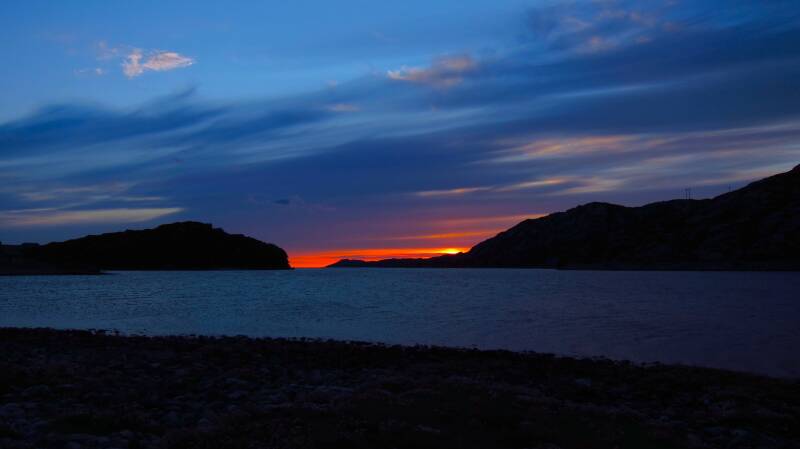
Photo below: another view of Loch Laxford looking out towards the open sea from the Loch. This image invokes the idea of Norse or pre-Norse sailors, who may well have known this loch or fjord as a navigational aid, as well as likely sailing into the loch themselves. When you look at the photo below, a Norse longship can easily be imagined, sailing somewhere towards the northwest. It is likely that speakers of Beurla Reagaird and speakers of "Pictish" would have had their own names for this loch too, and their own importance that they placed upon it. Looking at the image below, one can imagine this too.
More on Beurla Reagaird in Sutherland and Beurla Reagaird etymologies and explanations
One of Britain’s most mysterious and, on a societal level - unknown cultures, is that of the Indigenous Highland Travellers.
Like the Romani people for instance, the Indigenous Highland Travellers often moved from place to place seasonally. But when we look at the deeper history of the Indigenous Highland Travellers, we find a culture that has different origins to that of the Romani, and a culture with its own language, known as Beurla Reagaird.
I have come across numerous references (other than the one included further down this page) to Indigenous Highland Travellers being in Sutherland, and in Lewis, which is accessible across the Minch from Sutherland, and I feel strongly that the wild parts of the Sutherland Highlands may have once been important to Indigenous Highland Travellers as a part of their traditional lands, I have implied this without examples in other publications.
Beurla Reagaird is connected to Gaelic, for sure, connected being the operative word. But is Beurla Reagaird a form of Gaelic, or some offshoot of Gaelic? I personally doubt this to be the case.
Languages can share deep connections with each other, even down to a substantial relatedness in their vocabulary, without actually being genetically related to each other. Take for example the Quechuan and Aymaran language families in South America. Both language families share many similarities, including sharing a substantial amount of vocabulary in common. But fundamentally, the two language families are distinctly different, and there is no substantial evidence to suggest a common ancestor.
We can use this example when looking at the relationship between Scottish Gaelic and Beurla Reagaird. Yes, on one hand, one could interpret many Beurla Reagaird words as being “altered” or “deliberately disguised” forms of Gaelic words. And to some extent, a form of “disguising” may have taken place. But does this explain Beurla Reagaird, and its grammar and vocabulary as a whole? I do not think so, personally.
It is also possible that the relationship between Beurla Reagaird and Gaelic is more akin to that between Quechuan and Aymaran languages; i.e. two forms of language that have similarities, and have deep links, and deep correspondences in vocabulary, due to ancient shared contact within the same landscape; and yet the two languages do not necessarily have the same origin, nor do even belong to the same language family. Given the kind of relationships described here - Beurla Reagaird’s relationship with Scottish Gaelic would itself not even prove that Beurla Reagaird is an Indo-European language. I am not stating factually that Beurla Reagaird is non-Indo-European.
However, since we do not understand the origins of Beurla Reagaird; since it is only partially recorded, and considering the presence of Indigenous Highland Travellers as an indigenous culture, I do not think we should simply assume that Beurla Reagaird is an entirely Indo-European language, either.
Because Beurla Reagaird, and the Indigenous Highland Travellers and their culture, are simply not well understood enough on an academic and societal level for any assumptions about their cultural and linguistic identity to be fair or non-biased - in my opinion. In fact, I only learned about the Indigenous Highland Travellers a few years ago, and I feel that they, and their language, receive far, far too little recognition.
Some might argue that the Indigenous Highland Travellers are not a truly “ancient” indigenous culture. But I would argue that there is no evidence to suggest they are a “modern” culture either, and that their material culture, and lifestyle, in a relatively recent past, shared a lot in common with that of other mobile indigenous cultures throughout the Northern Hemisphere.
The Indigenous Highland Travellers traditionally used mobile dwellings. On the Am Baile website is the image: Travellers’ Summer Encampment, Highland Folk Museum, Asset ID: 48419, which depicts a traditional Highland Travellers's summer encampment, as created under the direction of Indigenous Highland Traveller Essie Stewart, who lived in structures like this in Sutherland in Northern Scotland. According to the information provided on Am Baile, the structure in the photo was constructed from hazel bows.
To what extent the dwellings, general culture, and language of the Indigenous Highland Travellers, might connect to those of prehistoric peoples in Britain, has yet to be fully researched. But the possibility that the Indigenous Highland Travellers and their language are a continuation of prehistoric cultures in Scotland, should not I think be discounted, and deserves serious consideration and research.
Below are 9 Beurla Reagaird words, with their possible relationships to Gaelic, and other words discussed. All the words below were sourced from the Beurla Reagaird: Pàirt2 blog post, written by Calum Rosach and on the dasg.org.uk website, I also used this source in an unrelated article published a few days ago, wherein I discussed a single Beurla Reagaird word, which I have not discussed in the list below, and which is a part of that other article, the link to which is: https://www.runic-serpent-777.co.uk/on-gaelic-some-other-languages-around-scottish-seas-publ-on-the-03-08-2026
- caran - “boat”. This word bares a resemblance to Scottish Gaelic curach - “coracle”, and to related words in other Celtic languages, believed to be related to Latin corium “hide” or “leather”, but ultimately the root is of uncertain origin. A resemblance can also be seen to Romanian corabie - “ship”, perhaps from Ancient Greek κᾱ́ρᾰβος, kā́răbos, - a "crab", "beetle" or "small boat", also of uncertain etymology.
- leasg - “light”. This word could be connected to Gaelic loisg - “to burn”, or perhaps to the Indo-European words connected to “light” *lewk-, this root *lewk- may for example give us Welsh lluched - “lightning”. But leasg does semantically, and phonetically, bare the greatest resemblance I think to Gaelic loisg and other Celtic cognates, although the precise relationship between these Celtic forms and Beurla Reagaird leasg cannot be determined. The word leasg also has meanings within Gaelic, but the meanings in Gaelic seem semantically unrelated to the Beurla Reagaird word.
- bein - “small”. The first part of this word bares an obvious resemblance to Scottish Gaelic beag - “small”. Could this be a Gaelic word “adapted” to Beurla Reagaird, or could the initial syllable have passed into Beurla Reagaird and into Gaelic from an earlier root, minus the [g]/[k] found in Gaelic (and other Celtic languages) and the [n] or variant thereof in Beurla Reagaird? It is tempting perhaps to see a similarity to Finnish pieni - “small” and Estonian peen etc.
- noid - “a man”. At first glance one might interpret this word as coming from the Gaelic word duine, but having been “disguised” with the consonants and slenderisation switched around, as it were. On the other hand, some languages, including English and Gaelic, also naturally reverse or switch around syllables or other phonetic elements to some degree; take for example the dialectal English word waps as a variant of English “wasp”. Furthermore, in some Afro-Asiatic languages, switching around, or reversing the consonants of a root word in this way, is perfectly normal and grammaticalised.
- sgian - “fish”. On the surface, this word looks just like Scottish Gaelic sgian - “a knife”, and one could see a hypothetical semantic link between a fish darting through the water, and the shininess of a knife for example. On the other hand, sgian also bears a resemblance to the Gaelic word iasg for a “fish”, but again, with the phonemes and slenderisation being re-positioned in the Gaelic and Beurla Reagaird forms. Could both connections be true, simultaneously? Ultimately Gaelic sgian connects to an “Indo-European” root meaning “to cut”, which could simultaneously apply to the act of a fish swimming, and therefore “cutting” through water, although I am more inclined to think that this Beurla Reagaird word may have been adopted from Gaelic more recently, due to the close similarity in form.
- geann - “dog”, if we substitute the orthographic g for a [k], this word bares a resemblance to Gaelic còin - “dogs” (cù in the singular), and to other Indo-European words based on the same root meaning “dog”, e.g. Latin canis - “dog”. But again, the precise relationship between the Beurla Reagaird and Gaelic, and other Indo-European forms, is not easily explainable, and geann is really not that similar to the Gaelic word for “dog”, any more than it is to other Indo-European words for “dog” from the same root word.
- liobhag - “a sheep”. This word bears a vague similarity to Gaelic lomadh - “shearing” and to related words in other Indo-European languages, e.g. Old Irish lomm - “bare”. Similarities can also be seen however to the English word “lamb”, Finnish lammas - “sheep”, even, I would argue, to Quechua llama - “llama”, another wool bearing animal. The words lìomh and lìobh also exist in Scottish Gaelic, but seem entirely unrelated semantically to Beura Reagaird liobhag.
- drocan - “a song”. When the reversal or repositioning of sounds is taken into account, this word bears some similarity, and a similar “sound” to the Gaelic word òran - “song”, likely connected to Old Irish amar - “wailing” or “singing”, and to Welsh afar, but with the root not having any known cognates outside of Celtic. Personally I think that this root could in-part be onomatopoeic, in which case the Beurla Reagaird word drocan might represent a variant of it, perhaps having become distinguished at an early time though, due to the presence of the [d] phoneme, or variant thereof, in the Beurla Reagaird word.
- sim - “a stick”. This word does not bare any close resemblances to Gaelic words for “stick”, to my knowledge. It is tempting for me to see a possible Uralic cognate, as in Finnish sompa - “rim of the lower part of a ski pole”, itself cognate to N. Sámi soabbi - “a staff”, with these Uralic words being connected to (but not necessarily from) Sanskrit स्तम्भ, stambha - "pillar", related to a possible Indo-European root meaning to "become stiff". The possible relationships between the aforementioned words do not necessarily mean that the root itself passed from Indo-European to Uralic.
Note that the aforementioned possible similarities with Uralic words are not included to imply that Beurla Reagaird is in any way Uralic; rather that certain similarities to Uralic could exist as one aspect of Beurla Reagaird’s vocabulary.
I hope to write more on Sutherland in the near future. This article is dedicated to the Norse, Picts and Indigenous Highland Travellers of Sutherland; to my family and animals, and to all whom I love, and to all that I love.