On flotoyggjar, Valinor, Rocabarraigh & The Green Isle, publ. on the 26/07/2026
Written and published by Linden Alexander Pentecost, and published on the 26th of July 2026. The two photos in this article were also taken by me, the author, and like the article have not been published before. This article is unrelated to and separate from any and all of my other publications, including others where I discuss different aspects to these topics in great details, for example, my other articles concerning Tiree and its flood legends on this site, and things I have published elsewhere, etc. The descriptions above the photos also contain information not in the main text. This article was published in the UK and no AI was used in any part of it nor in any of my written works. This article contains 1871 words and was completed at 21:30 PM on the 26/07/2026.
I have had flu for the past week, and a few nights ago, as one sometimes does when one has flu, I had strange and intense dreams. I did not sleep deeply, and kept waking. I was aware of my physical body, but in the dream realm, I was in Tiree. I didn’t know what I was doing in Tiree, but I remember being at various brochs and duns on the island, and I remember I was with others, and discussing things with them, whilst also aware that my physical form was here, which was strange.
At the end of the dream, I saw something strange (if the dreams themselves were not already strange enough): I saw a vision of the ocean, gloomy, but becoming clearer. I could see the surface of the sea, dark, from a rocky shore. But superimposed, slightly above the surface of the ocean, and somewhat translucent, was another ocean surface. As I concentrated more upon this “other” ocean surface and followed it towards the horizon, I saw an island, or, a dark mass, that seemed to be floating in the sky and in the ocean. It was in the distance. There was very little colour in this “vision”, the island or object was black, the sky and ocean towards the horizon were a mysterious dark grey, touching upon purple and blue tints.
This was just a dream of course, at least, to other people. But it felt deeply mysterious. And there is a story here to tell. First of all, those who are fans of Tolkien’s Middle Earth, have likely heard of Valinor, the mysterious island located across the Western Sea in Tolkien’s World, inhabited by the Valar, divine, angelic beings.
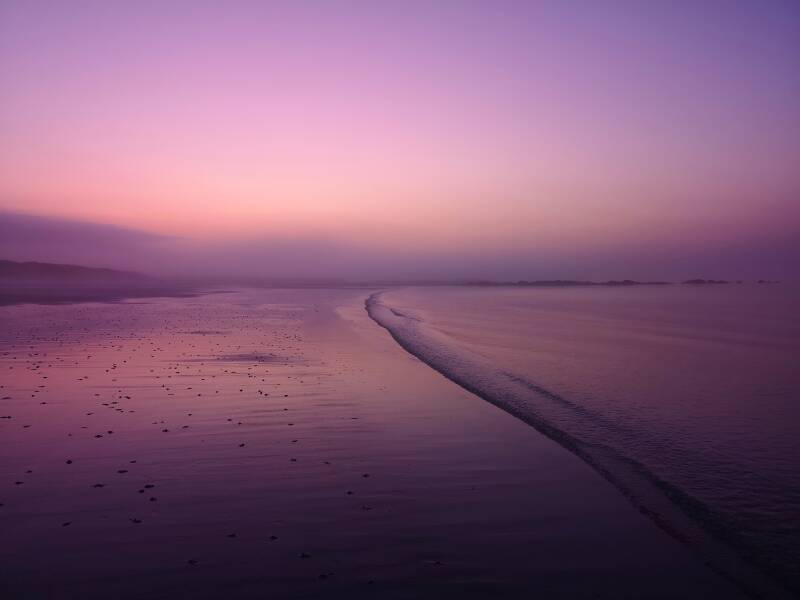
Photo below: an early, misty sunrise taken from the beach south of Crossapol on Tiree, taken after my first ever night on Tiree in June 2023. Wow, a lot of rhyming in that sentence! This photo I hope helps to invoke the mysterious kind of atmosphere of these flotoyggjar or "floating islands", of which Tiree is not one, but Tiree is without a doubt connected to this wider concept of vanishing islands, as I discuss in this article. I hope and believe that the photo below helps to invoke the atmosphere and magic of the floating islands, which are themselves often said to be surrounded in mist, or to appear out of the mist. The photo below also gives me feelings of "Valinor" in a rather powerful way.
We can think of Tolkien’s Middle Earth as an entirely fictional, made up “con-world”, but this is not I think true. Certainly many aspects of Tolkien’s legendarium can be thought of as an attempt at unifying parts of actual northwest European mythology under a common framework and narrative. Even Tolkien’s choice to make his Elvish language Quenya, have similarities with Finnish, whether deliberately or not, also I think connects to actual mythology.
The Elves travelling to Valinor for example, can be viewed as similar to the concept of Fin-men and Finfolk as magical peoples known from the Shetland and Orkney Islands, both mysterious “Finn” peoples were associated with the sea. Similarly to how the Elves are able to sail to Valinor, the Finmen of Shetland are associated with mysterious “floating islands”, which are connected to the same wider archetype of the mysterious, phantom island, of which Tolkien’s Valinor can also be considered to be.
Whilst the name Quenya, bares a similarity to the Norwegian word Kven, a Norwegian word to donate a Finnic speaking people at the top of Norway, specifically an area long associated with magic and with witchcraft. The Kven people themselves refer to themselves as Kväänilaiset or Kainulaiset. They are distinct linguistically and culturally from the Sámi peoples, but they too are a part of this wider idea of magical peoples at the north of Europe, and both referred to historically as Finnar, “Finns”.
The Faroe Islands have a mysterious mythology around the concept of what they call flotoyggjar or “float islands”, and according to some beliefs, some of the Faroe Islands were once “floating islands”, that, to my understanding, became in a sense “tethered” to this reality if iron is placed onto them, a belief which may pertain to the idea that an object made of cast iron is able to prevent a person from becoming lost in the faerie realm; and perhaps we can also see a connection here in how our own Earth’s magnetic field is connected to gravity and to the shape and dimensions, and content of our physical world.
The concept behind Flotoyggjar is essentially, that some islands do not behave as though they are entirely a part of our physical world. They disappear, then reappear somewhere else, and they seem to “float” on some plane, whether it be ours, or one close to ours but distinct and separate from it.
The North of Norway has several legends of such islands, for example the island of Utrøst, a mysterious phantom island said to appear to the west of the small Røst archipelago to the west of the Lofoten Islands. As with Valinor and many of the other examples here, these islands are very often located “west”.
Another example of a “floating island” legend connected to the North of Norway, is that of the island of Sandflesa, off the coast of the island of Træna, located in Helgeland in Northern Norway. Another is the island of Utvega.
One thing here which I would like to bring up, is that I think there may be some connections between the legends of these islands and prehistoric tsunami events, which, similarly to how the islands appear and disappear, made parts of the land disappear, and in a sense “cut off” parts of the world physically, in a similar vein to how these phantom islands are described as being “cut off” in some way from our physical world.
The Faroe Islands for example were struck by very large waves from the Storegga Tsunami, which occurred during the Mesolithic time. The Shetland Islands, with their legends of Fin-men, floating islands, and the Finnigirt Bank, which some believe to be of Mesolithic Origin, were struck by even larger waves from the Storegga Tsunami, where it was at least 20 metres tall.
The Northern Coast of Norway would also have been greatly affected by the Storegga Tsunami, but even more specifically interesting is that the phantom island of Sandflesa, said to be off the physical island of Træna, close to where the Trænadjupet Slide occurred, another ancient cataclysm like the Storegga slide, was triggered by the collapse of sediment on the continental shelf, although it is not known whether or not the Trænadjupet Slide created a tsunami. In a similar vein, Tolkien describes how similar disastrous events affected, and altered the physical relationships between our world and the “Undying Lands” to the west, including Valinor.
But this is not to suggest that what is being discussed in any of these mythologies entirely relates to natural disasters and to changes on the physical level. Both Tolkien’s, and the real world mythology implies that these islands are still there, and of course the real world mythology does not always connect the disappearance of the islands with natural disasters. But sometimes it does.
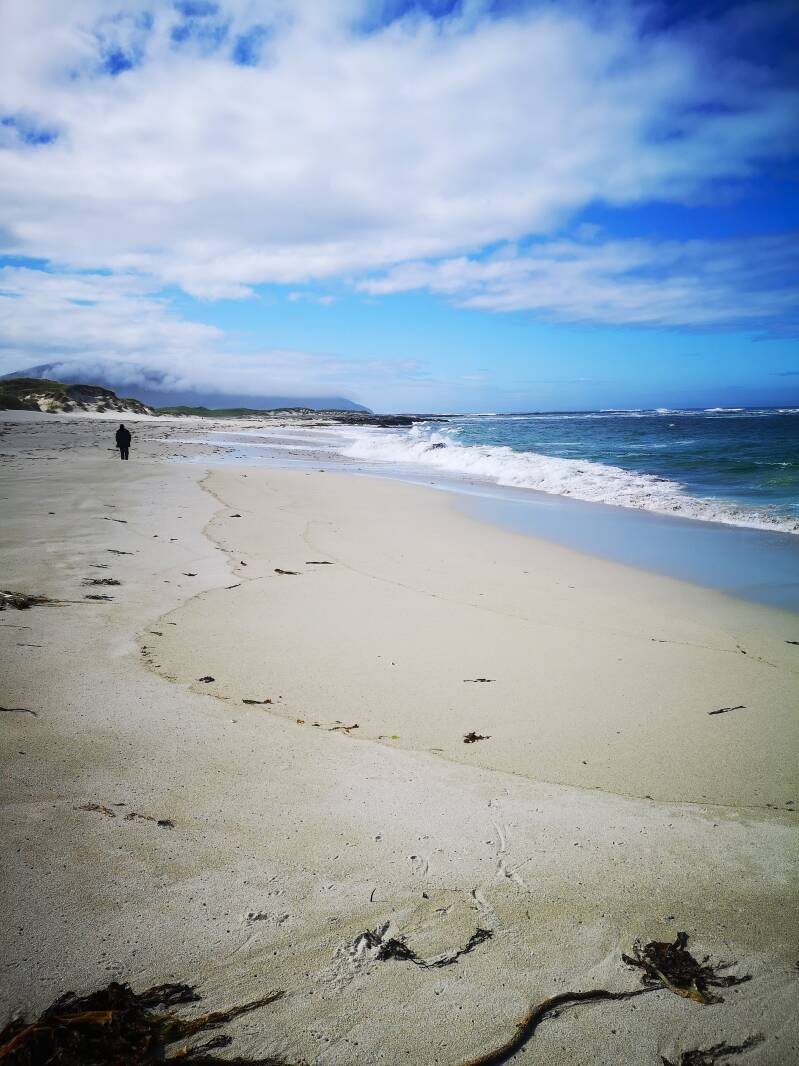
Photo below: a photo taken on the west of Barra near Allasdale/Allathasdal on the west of the Isle of Barra, taken in Spring 2023. My late grandad, David Kaye, is walking along the beach towards me. My grandad also loved Lord of the Rings, and even more, he loved the Hebrides, and he loved the sea. These areas around Allasdale are also the remaining "extension" really of those inundated lands to the west of Barra. I feel that the skies in this photo also give a true mystical sense of these otherworldly islands discussed in this article, both physical and non-physical islands that is, and their magic and holy beauty.
In the Hebrides in Scotland, the island of Rocabarraigh is another phantom island, said to be located to the northwest of Barra in the Outer Hebrides, which was said to have disappeared due to an earthquake, at the same time as a large part of the island of Tiree sank. Indeed, the Storegga Tsunami, whilst smaller in the Hebrides, would have affected Barra and Tiree; and the Outer Hebrides, including Barra (but not Tiree) have had a general tendency to sink in relation to the sea over the past 10,000 years, so indeed the Storegga Tsunami would have submerged and inundated lands to the west of Barra, temporarily, although the tsunami would also have destroyed or damaged soft-sediment landscapes permanently.
Similarly, another mysterious phantom island known in Scotland, was known as The Green Isle or An t-Eilean Uaine. In The Real Green Island, by Raghnall MacilleDhuibh, (published on the 29th September 2006) it is written that this island was thought to be located between the islands of Tiree and Barra. I had always wondered what felt so “special” about this particular area of the sea. Indeed, Tiree is also known poetically as Eilean Tìr fo Thuinn - “Island of the Land Under Waves”, demonstrating another association between Tiree and the idea of a sunken land in proximity and in connection to Tiree.
Whilst Rocabarraigh is sometimes said to just be the rocky outcrop of Rockall, a physical island, it can also be said that perhaps Rockall is the physical anchor or remnant of what was once considered to be a much larger land-mass, whether or not entirely of this world.
I do not know how much more of this I can uncover from the mythology of Barra and Tiree, but I have discussed important other aspects to these things elsewhere, a lot. Soon I would like to discuss the island of Буян, “Buyan”, a phantom island known in Russian folklore.
Make of these topics what you will. I hope that for residents of Barra and Tiree, this information is particularly fascinating, and helps to inspire a still deeper sense of just how mystical and wondrous your islands are. This article is dedicated to the people of those islands, and to those mysterious guardians, what Tolkien calls Valar, and what others called Finns, living in those lands out to the west, which perhaps again we shall come to understand.