A Tiree serpent stone (Ringing Stone) & more the legends of Tiree's ancient flood publ. 25/06/2026
Written and published by Linden Alexander Pentecost on the 25th of June 2026, this article is unrelated to and completely separate from any and all of my other publications, even though there are certain crossovers sometimes, all of my publications are unique. The 3 photos in this article were also taken by myself the author. No AI was used in this article nor in any of my written works; this article was published in the UK and only on this UK website, I the author am also from the UK and live in the UK and published this article in the UK. This article contains a total of 1919 words. The photo descriptions above the photos also contain information not in the main text. Note I have published unrelated and separate other publications connected to Tiree and to some of these other topics (sometimes many connecting topics in one place) in other forms and places recently, including for example an unrelated recent article about more flints on Tiree, polyamory and other topics (published on a different website), and other publications about or connected to Tiree; note that this article on this page is unique from all other publications. This article contains references to adult female breasts in symbolic contexts but in a non-sexual way, note also that this site does get flooded by the sea and that there are several extremely dangerous chasms on this area of coastline, which can be 20 foot deep, but seem like just a small depression until you're close, so be very careful, I have made similar warnings in other, unrelated recent publications connected to Tiree. Final edits were added to this article at 6 pm on the day of publication, the 25th of June 2026.
Yet another archaeological site that I visited recently when on Tiree is the Ringing Stone, or in Gaelic: Clach A’ Choire. This is without doubt one of the most interesting and unique archaeological sites I have been to, even if the shape of the stone is that of a typical “serpent stone” as found elsewhere. I say this because these particular megaliths are shaped like the head of a dragon, serpent, fish or giant bird, but they all generally have a similar shape, and seem to represent the idea of the cosmic serpent, of land energies, and multiple other things, much of which I have discussed in detail elsewhere, including recently in unrelated publications.
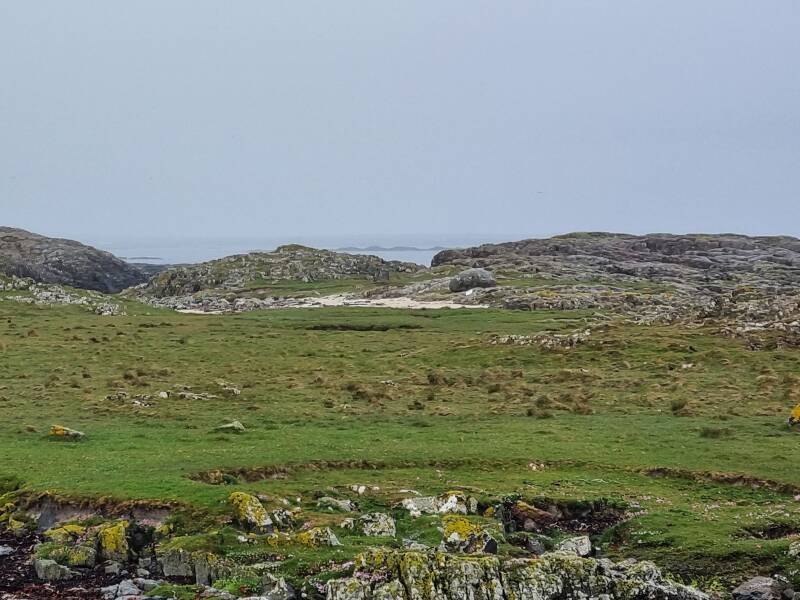
The Ringing Stone is in an unusual place, situated some distance down the shoreline and on the edge of the Upper intertidal zone. The land in Tiree has generally “risen” out of the sea, implying that if basic geological processes are to be believed, the stone was underwater until the land rose, after which the markings on the stone would have been made, in the Bronze Age for example.
Unless of course the stone was in situ at a time when the sea levels in Tiree were much lower and was moved there during an earlier ice age or series of events. This subject connects back to that concerning the ancient flood of Tiree, which I have discussed other aspects of elsewhere, but will to into new details about this further into this article.
Photo below: the Ringing Stone/Clach A' Choire taken from an angle showing the "front" of what I feel appears to be a serpent- or bird-head shape, essentially the "point" or "beak" on the right side of the stone can be seen, with the right side of the stone being more beak-like than the left side, giving it a kind of "head-shape". In a sense perhaps the breast-shaped markings could also be interpreted simultaneously as being like multiple eyes, which would again imply a commonality with certain cthulhonic gods. Note that I also discuss other aspects to Cthulhonic goddesses in Scotland elsewhere, including in my unrelated most recent Silly Linguistics magazine article, titled: "More on the unique Gaelic dialects of Mull - and on the origins of Gaelic in the Hebrides & the witches of Mull" By Linden Alexander Pentecost, published in Silly Linguistics Issue Issue #97 June 2026. Note that I publish in the UK exclusively but for a small number of my works get published in South Africa via the aforementioned magazine.
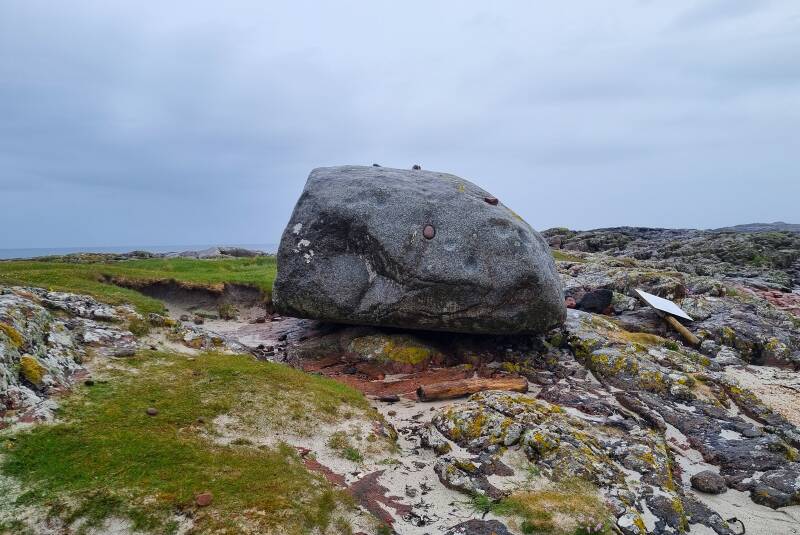
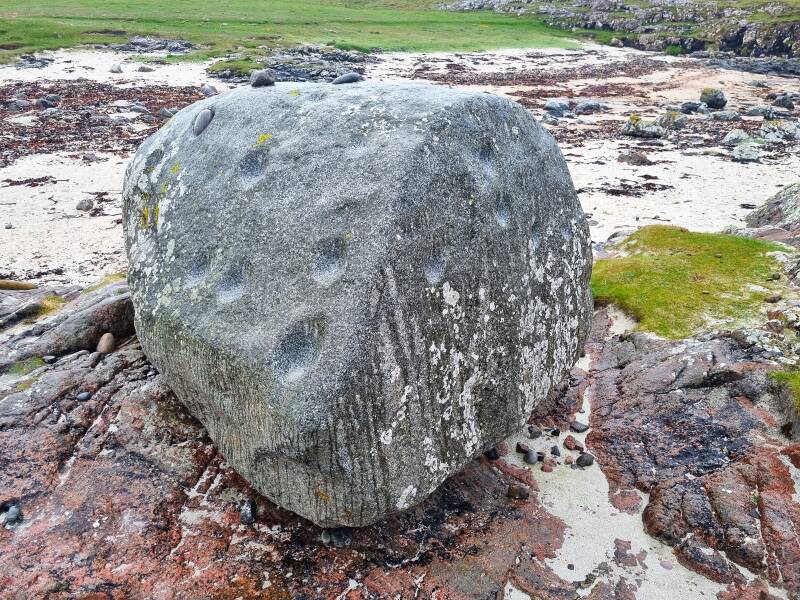
The markings on the stone are their own point of intrigue. They are described in some places as being cup-marks, yet they are unlike any other cup marks I have ever seen elsewhere. For one, they are generally much larger. For two, they seemed to be specifically shaped like indentations created around the shape of female breasts.
In some traditions there is an idea that these types of markings were created whilst the rock was soft, and it is implied that the beings of the faerie realm, or ancient ancestors cultures, were responsible in some way for making these markings - with the implication that the rock was “soft” or “malleable” at the time. In this case, almost as though female goddesses and faerie realm ancestor women “created” these indentations upon the Ringing Stone from their breasts, whilst the stone was soft. This is at least I think the underlying dream-time, otherworldly implication, or one of them.
This is also suggestive of the association between female fertility energy and the serpent, kundalini energy archetype. In what sense these things could be connected in this instance is a little confusing to me though.
Now there is a very interesting link here with the “Many Breasted Diana” goddess found in Greek tradition, who was originally depicted as a palm tree with a meteorite, her essence sitting upon it. She later became depicted as a goddess covered in many breasts. We see this idea of a goddess figure that sustains life and energy in the landscape, and how the breasts might metaphorically connect to the rivers, lakes, energies, celestial, earthly and otherworldly, which bring life to the world.
Photo below: The Ringing Stone as seen from behind, note the flat face on the back of the stone and the many, many adult breast-shaped indentations, both on the back but with larger examples on the side to the left.
But - there is this meteor association with “Many Breasted Diana” too, and in a sense, we find a very similar mythological theme existing around the Ringing Stone. Whilst the Ringing Stone is not a meteorite, its appearance as being out of place invokes a meteorite-like impression. Furthermore, the stone came from the Isle of Rùm and is not geologically from Tiree. It must have been “carried there” by the ice, although one does wonder if some more magical means could have moved it there, at least in the folklore.
In the aforementioned ways the Ringing Stone is akin to a meteorite, it is “unusual” and “came from somewhere else” in a similar metaphorical sense. But furthermore meteorites are associated with cataclysms. The Ringing Stone, is also associated with the concept of a cataclysm. Fascinating right?
There is, as I have discussed in detail elsewhere, this legend about a large portion of Tiree having “sunk” at some point in the past, at the same time as the mystical island of Rocabarraigh was said to have disappeared, west of Barra and possibly of the sound of Barra. This legend is only mentioned in one place to my knowledge in the book: The Gaelic Otherworld - John Gregorson Campbell's Superstitions of the Highland and Island of Scotland and Witchcraft and Second Sight in the Highlands and Islands, edited by Ronald Black; and I have discussed the reference in question in detail in other publications.
There is a legend about the Ringing Stone however which I did not know about until my second trip to Tiree, and which seems also to connect with the idea of an ancient flood affecting Tiree and elsewhere. As I have also discussed elsewhere there is a stone on Barra called Clach Mhór nan Gleannan, and the legend about that stone, which I discussed elsewhere, is also very akin to that about the Ringing Stone on Tiree. I discuss Clach Mhór nan Gleannan and a few other aspects to these floods in some unrelated articles published on this website and also in other unrelated publications elsewhere.
Photo below: a photo of lower quality showing the Ringing Stone in situ upon the coastline towards the upper end of the intertidal zone - which is not to say that the sea doesn't frequently inundate the area - it does!
The Ringing Stone mythology I refer to can be found in part 10 (consisting of two pages, one with the English version of the story and one with the Gaelic) of the bilingual book: Tiree Tales Sgeulachdan a Tiriodh by Fiona E MacKinnon.
The part of the legend in question in the aforementioned source refers to that if the Ringing Stone is ever moved or shattered then Tiree will sink, i.e. sink into the ocean, which is a blatant and obvious association between this stone and the idea of a cataclysm. Could it also be perhaps that this stone is more fundamentally connected to the idea of a primordial sea goddess, who comes from the heavens above and who becomes the creator and sustainer of life, the heart of the whole world? And could this warning about the stone ever being broken or moved refer to this idea that this goddess figure is the heart of creation, so if she is hurt then everything is hurt?
The placement of this stone on the beach is also extremely curious, and may be on some level representative of this idea of a primordial sea goddess coming ashore, with the stone in a sense making where the human, land world, and the cosmic oceans and skies come together.
Lastly I would like to briefly discuss this whole “ringing” aspect. The stone is named such in English because if tapped with a small stone in different places, the Ringing Stone “rings” and produces different notes. The breast-shaped indentations may relate to this. Could the breast-shaped indentations also be representative of different female energies, different songs and sounds, words, flowing out and attuned to different energies in the natural world?
It is also interesting for instance how the shape of a breast is akin to that of a dome, the dome-shape being ideal for amplifying sound in certain ways. We furthermore find this throughout mythology, including the implication of a cavern in which King Arthur sleeps, and this idea of a bell, also breast-shaped and dome-shaped, producing sound in the cavern to wake up the warriors.
I have preciously connected this in other publications to the dome-shaped Pike O’ Stickle in Langdale, Cumbria, and to how the rock mined from that mountain in Neolithic times also produces a strong “ringing” sound. We can also associate these axe heads with the idea of celestial forces of creation and with the ideas of “thunder”, “meteorites”, the “thunderbird” and “horned serpent” archetypes, all of which seem to be connected in some way to trickster and fertility deities and energies, and furthermore to the idea of magical celestial languages.
I hope that this article has managed to successfully cover these things in question connected to the Ringing Stone (I believe it has). This article is dedicated to the Ringing Stone, those ancestors connected to it, and to the people of Tiree, past and present and future.