C1: More on ancient Kirksanton & Lacra & ancient language, published on the 22/03/2026
Written and published by Linden Alexander Pentecost, published on the 22nd of March 2026. This article is unrelated to and separate from any and all of my other publications, no AI was used in this nor in any of my written publications, and this article was published in the UK, and only on this UK website, I the author am also from the UK and am a resident of the UK. The five photos in this article were also taken by me, the author, and were taken back in the summer of 2016. This article contains a total of 4255 words. The photos and article have never been published before and are unrelated to other publications in which I have discussed this area and some of these sites in a different way. The photo descriptions in italics above the photos also contain information not in the main text. Note that I will publish some unrelated publications in the coming week. The five photos in this article are of Lacra Bank, of two different angles of the Giant's Grave at Kirksanton (unrelated to other photos of this site I have published elsewhere), and photos of the Lacra Stone circles B and C. Note I have published many unrelated things recently, with separate publications as articles on different websites (not just on this website you are on, www.kielimatka-2-11.co.uk nor just on the other websites mentioned in this article), and also separate material published in new PDF-only book publications. Note that in the PDF book I most recently published I also discuss things connecting to the ancient Isle of Man & its standing stones, and to Cumbria but this is again unrelated to the material and specific things discussed in the article on this page. I also plan to publish yet another PDF-only book the day after tomorrow & will publish some unrelated blog posts on another website tomorrow (tomorrow being the 13rd of March 2026, this article in front of you was published on the 22nd of March 2026).
For me personally, the area around Kirksanton in West Cumbria is really very magical. I can’t explain why exactly in technical terms, I mean, Cumbria in general is very magical, and has a lot of amazing sacred sites. But I think perhaps that the area around Kirksanton and Lacra feels special to me, because it is one of those places in Cumbria, that feels close to the Goidelic and pre-Goidelic worlds. Which is to say that this part of Cumbria is open to the Irish Sea, and is a “part” of the Gaelic world, and pre-Gaelic world. It may be in Cumbria, but when one goes to the stone circles and stone avenues of Lacra, and to the Giant’s Grave at Kirksanton, one can somehow feel on an ancestral level, that they are in a part of the Goidelic or pre-Goidelic world, and that they remain to be, despite being in Cumbria.
Note: from what I understand from the work of a researcher, these type of sites should be entered from a southerly direction as the energies can be dangerous, although this "does" depend upon the individual sacred site, and also depends on for example the intensity of the moon's power at any particular time. As with all things like this, this has to be worked out on a site by site basis, by seeing how one "feels" in different areas of the site for example. It is I think best to avoid these sites during the Full Moon.
Lacra Bank, and the Lacra Stone Circles, which I also discuss in this article, have some place-names close to them which are the first place-names I wish to discuss in detail in this article, I will discuss "Kirksanton", "Lacra" and others further into this article. One interesting place-name on the same mountain formation as Lacra Bank, is the place-name Harrath. According to what I understand from the book: THE PLACE NAMES OF SOUTH CUMBERLAND COLLECTED AND ANNOTATED BY REV. W.S. SYKES, M.A. With notes on boundaries and further references to places in S. Cumberland from the Note Books of the Rev. W.S. Syke , the place-name "Harrath" seems originally to be have been "Harrats", although it is equally possible that "Harrats" is not the correct form, and that Harrath is. Also according to what I understand from the aforementioned source, there are also traces of ancient enclosures at Harrath. Could Harrath be an ancient place-name and correspond to those ancient enclosures? I have no thoughts on this moment in time about the exact meaning of this place-name. Closeby and more on the lowlands towards Millom is the place-name Pannatt Hill. This, and the Harrath place-name may possibly contain a suffix, *-Vt which I have previously associated with the Cumbric or pre-Brittonic/extra-Brittonic language. I have discussed this elsewhere. The first element, Pann- could perhaps be connected to Cumbric/Extra-Brittonic *penn - "head". Whilst in this article I focus more on connections with pre-Goidelic and Norse-like languages, some of the ancient linguistic elements in this region are more closely aligned with (pre-)Brittonic, another example being the place-name "Pen End" located close to Black Combe. Another curious place-name around Lacra Bank is Hellpool Bridge, a name which may, possibly, contain implications of a meaning connecting to the Germanic underworld of "hell", I discuss this later in this article too.
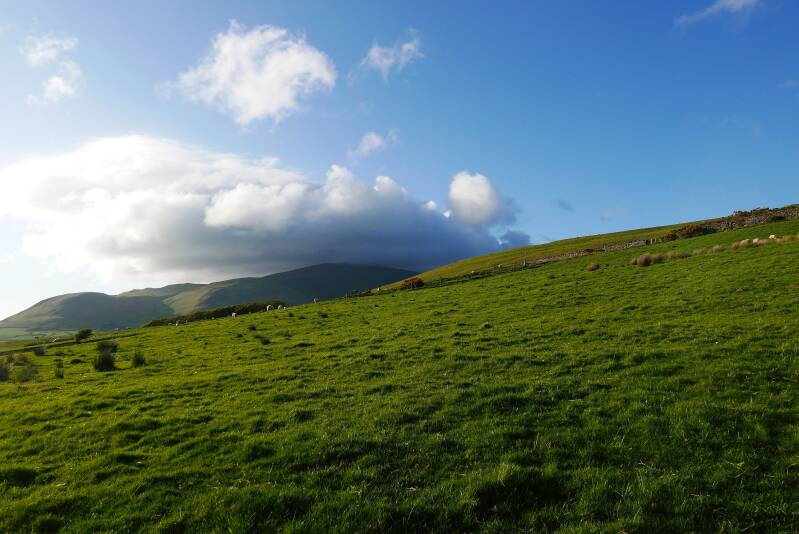
Photo below: a dramatic summer evening view from the hill/mountain of Lacra Bank, and its green slopes, with the mountain of Black Combe behind, its summit slightly in cloud. I think that the photo below gives some impression of the imposing, magical and ancient feeling of this place, a feeling which seems to go beyond time. Certainly when I look at the clouds over Black Combe in the photo below, I feel I am looking upon a scene as ancient and connected to those ancient people as it is to my own existence and time.
Goidelic refers to the Goidelic languages, Irish, Manx and Scottish Gaelic. Kirksanton and Lacra face the Isle of Man, and beneath the layers of Norse language in West Cumbria, we find evidence of a Goidelic or Goidelic-like language. When I say Goidelic-like, I mean that, although the connections between West Cumbria and the Goidelic World may be thought of in medieval terms, the fact is that the connections between West Cumbria and Ireland, the Isle of Man and Scotland, go back many thousands of years, and it is honestly impossible to tell, usually, if these linguistic influences came from the so-called “Norse-Gaels” of the medieval era, or if they came from pre-Goidelic language speakers and are many thousands of years earlier. As well as the examples of and aspects of this picture I discuss in this article, I have also extensively discussed other aspects and examples of this in other publications, including in several books, one of which is a book published via one of my other websites called Clwàideac-na-Cuinne, the book can be acquired from the website and the book is titled: More on Britain's linguistic past, and prehistoric, runic, slate and copper mine related and other aspects primarily to Western Britain and connected topics, this pdf-only book is published via clwaideac-na-cuinne in the UK on the 17/09/2025 . Since publishing the aforementioned book and before writing this article on this page I have also published many other things about these subjects, one example of which is an article on another of my other websites, Languages-of-Linnunrata, the article on that website being titled: The possibly ancient fish traps opposite Kokoarrah Scar, and on ancient local language, published on the 13/02/2026, the link to which is: https://www.languages-of-linnunrata.co.uk/3000883_the-possibly-ancient-fish-traps-opposite-kokoarrah-scar-and-on-ancient-local-language-published-on-the-13-02-2026 . I also published for example a Kindle-only book last year that discusses giants and other topics connected to the Isle of Man and the Giant's Graves at Kirksanton, but this again contains completely different information to that in the article on this page; and I have also published a lot more about other aspects of these sites, giants, landscapes and language links in other publications, some of them recent, but again separate also this one.
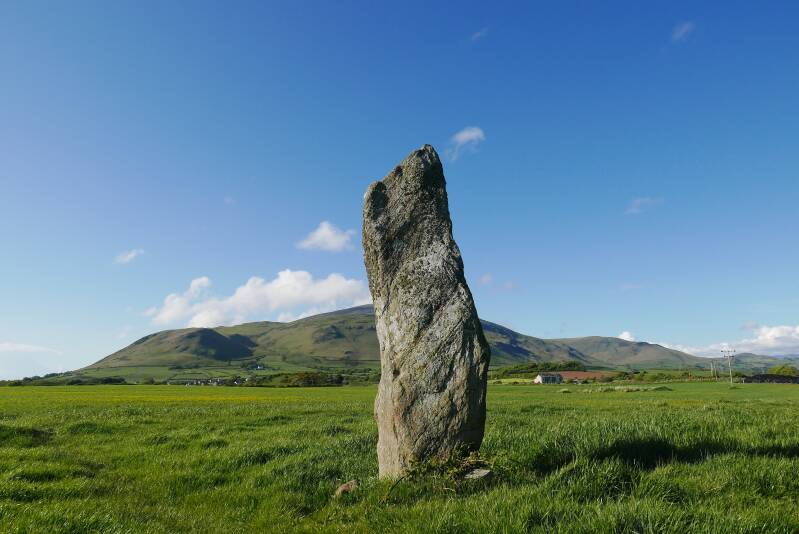
Photo below: one of the two standing stones at the Giant's Grave in Kirksanton, West Cumbria. This stone and the landscape it is in, is to be breathtaking, the place has an atmosphere which to me feels peaceful, special, and somehow healing. The landscapes are open and the skies are vast, something about this places makes me feel connected to the ancient pre-Goidelic world. The mountain behind the standing stone is Black Combe, a mountain which itself boasts many ancient cairns, and the beautiful Swinside or Sunkenkirk Stone Circle is located within the same range of fells, albeit further inland.
The name Kirksanton itself is more easily identifiable as a later “Norse-Gaelic” name. The word “kirk” is both the Northern English and Anglo-Norse word for “church”, and kirk is also the term used today in the Cumbrian dialect. The -santon element is likely related to the Old Irish name Sanctán, referring to an early saint of Gaelic Christianity, who was said to come from Britain to Ireland. This demonstrates a later connection between Kirksanton and the Goidelic-speaking world, although it is also possible that many of these “saints” were originally pagan guardians who - may well have been associated with particular individuals during the medieval period, but who as archetypal entities, connected to the sacredness of the land - may be far older. This saint or figure Sanctán is also connected to the Isle of Man, and in particular to the Parish of Santon on the Isle of Man. Does this Christian connection between Kirksanton and the Isle of Man lie upon a rebranded, older pagan connection, between the Kirksanton area and parts of the Isle of Man? Given the historic and linguistic connections, this is not inconceivable. Note that the Parish of Santon on the Isle of Man is also sometimes referred to as Kirk Santan Parish.
Kirksanton’s most impressive archaeological site is the Giant’s Grave, located in a field on the outskirts of the village. This is just one of several “giant’s graves” in West Cumbria, and it seems, as I have written elsewhere, that these “giants”, whether taken as literal or metaphorical, have some connection to the Goidelic, pre-Goidelic or pre-Brythonic traditions in Cumbria. Think for example how the Fianna in Ireland, as well as the Fomorians were considered sometimes to be giants.
The Giant’s Grave at Kirksanton is also not a typical Cumbrian megalithic site. Cumbrian standing stones do not usually occur in pairs like the two at the Giant’s Grave at Kirksanton, and when they do, they tend to be smaller, or wider and of a different shape to those at Kirksanton. Furthermore, both of these standing stones at Kirksanton are pretty tall, and in general, the site gives more the impression of some of the standing stones on the Isle of Man or in the Outer Hebrides for example.
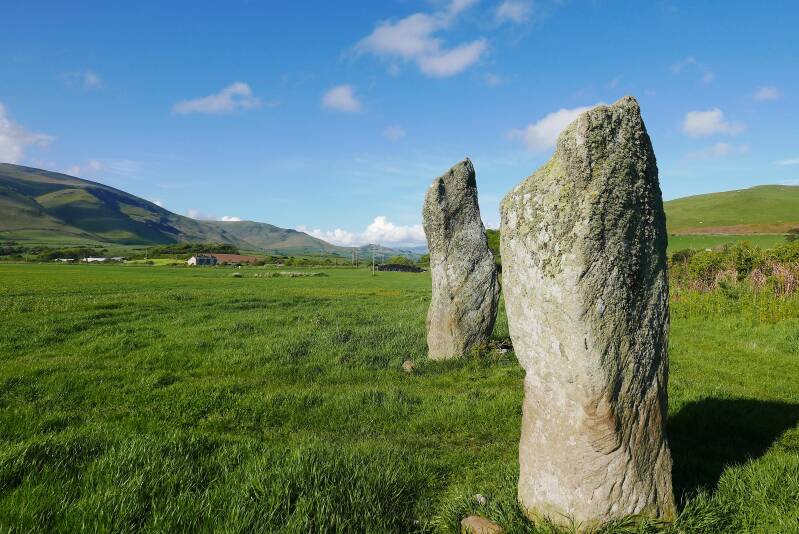
Photo below: both of the standing stones at the Giant's Grave of Kirksanton. The surfaces of these stones, their texture, the way they reflect light, are all very striking to me. The clouds in the distance, the green mountains and blue sky add to the impression. These stones seem to me to be a form of entranceway, and their alignments to the surrounding landscape are just breathtaking. Note how the stones have tall, humanoid shapes, and from certain other angles, "faces" can also be seen. There are also some cup markings on these stones, but they are not visible in the photo below. I believe that the photo below helps to give a good idea of the beautiful majesty of this site. Several other standing stones are also in this immediate area, and it is likely that at one time there were several ancient monuments forming a complex close to the Kirksanton Giant's Grave. As I have discussed elsewhere, a lake also existed close to these stones during the Bronze Age period.
There is also the “Giant’s Chair” located just behind the village of Kirksanton, although so far I have been unable to locate it. When we find “giants” and other such beings associated with particular sites in this way, it most often connects in some way to the ancient sacred landscape, wherein giants, as well as being physical beings, represent the ancient sacred creative processes that “drew” the lines of the landscape, and set the sacred places in their positions, in physicality, and in story and in ritual. The later Christian traditions in Cumbria about saints, the building of churches, and sacred springs etc, are invariably tied into this earlier landscape of pagan language and meaning. It is worth keeping in mind that the original Gaelic Christianity was something that existed alongside paganism, it can be compared to the way in which there are a multitude of goddesses and gods in Hinduism, but that certain individuals will dedicate themselves to particular deities and practices. In the original Gaelic Christian World, the landscape was still pagan, and the people we identify as Christian were more like a sect, a group, seeking the divine in a particular way, for example on certain sacred islands, in isolated places.
The difficulty is that such a sect could well have existed prior to Christianity as well, and I am personally of a belief that there could have been a Christ-like figure, and a concept of a universal “one God” or “Great Mystery” in pagan times. In a sense, I think of the original Gaelic Christianity as merely a slight re-description and re-classification of these earlier traditions. Even the so-called Celtic cross is not a Christian symbol by origin. Some of the so-called “Norse-Gaelic” Christian crosses, could be misidentified pagan crosses, with depictions of what we take to be a Biblical story actually corresponding to something much older. The clochán beehive-shaped stone huts, circular huts, built with drystone walls that gradually get closer and form a corbelled roof, are often associated with early Christianity. But it is possible that some of these structures pre-date Christianity, and furthermore, similar building techniques were used back into prehistoric times. Many of these misidentifications may result from the way in which the organised church seeked to gain control over peoples’ minds, re-write history, and to suppress indigenous cultures and to bring people under the control of a few. This later war-hungry and power-hungry Christianity is so incredibly far apart and disconnected from the ancient Gaelic understanding of God, and the original meaning of its symbolism and beliefs.
There are quite a lot of interesting stone circles on the west coast of Cumbria. The stone circle on Birkrigg Common may belong more to the Morecambe Bay prehistoric area, in my opinion, whilst those north of Millom, including those at Lacra, do I think come from a particular, mainly Bronze Age cultural setting. The stone circle at Sunkenkirk or Swinside is no doubt connected to those closer to the coast, but it is of a very different style from them. The more typical examples nearer to the west coast, include the four stone circles at Lacra near Kirksanton, the Greycroft Stone Circle near Seascale, the Yewcroft Stone Circle near Egremont, and the Studfold Stone Circle near Gilgarran. The name Gilgarran is perhaps itself derived from a Goidelic or pre-Goidelic word which appears as garrán in Irish, meaning a "grove". This word has pagan connotations, and I suspect that the word might be of pre-Goidelic origin, thus perhaps connecting it with the people connected to the Studfold Stone Circle.
There are many other stone circles in West Cumbria but in slightly more upland areas, and although these stone circles show similarities to the aforementioned sites, they, to me at least, seem distinct from them. Gilgarran and Studfold Stone circle are not located directly on the sea and are also some way inland, but they are not in an upland area, and this part of Cumbria, if I remember correctly, would have had higher sea levels in the distant past, and the original position of the sea may have corresponded in some way to the earlier manifestations of these cultural and linguistic links, and where they are situated within the landscape.
There were also many other stone circles in the particular area I am concentrating on in this article, along the coastal plain north of Millom, which have now been entirely or mostly destroyed. The Gretigate Stone circles are located near to Gosforth for example, but have now been mostly destroyed. There was once a circle of twelve stones at Annaside, north of Kirksanton, but apart from one stone, this site has now sadly been destroyed. According to what I understand from the book: Millom and District Prehistoric Past by Jan Bridget, there were likely many other stone circles in this area, which have now been completely or mostly destroyed.
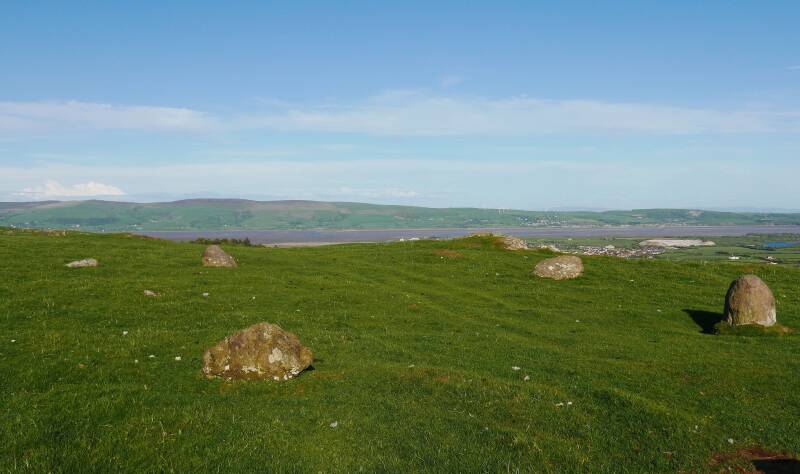
Photo below: the Lacra B Stone Circle, although the stones are not huge, the site leaves a strong impression and is very beautiful. This stone circle is likely of Bronze-Age origin, and by this time, many stone circles were built on a smaller scale. Nevertheless, the creation of this stone circle would have taken considerable effort. As with other stone circles, I feel that the stones at Lacra B stone circle have been chosen deliberately and may also in this case have been altered. The shapes and make-up of the stones seems to have been very deliberate. I also feel that these stones have life, a consciousness, as I feel with other ancient stones. The Duddon Estuary and Furness Peninsula can be seen in the distance.
I have not yet been to the Greycroft, Yewcroft nor Studfold stone circles, but I have been to the stone circles B and C at Lacra, which are located a short, but steep walk up from Kirksanton, and are located upon the same hill that the Giant's Chair is located, which is known as Lacra Bank. This hill, or small mountain really, has at least four stone circles upon it, believed to be part of a funary complex, although I suspect that they had many other meanings and purposes too within their cultural, linguistic and religious contexts. There are also several stone rows on Lacra Bank and in the same general area, although like the stone circles, these have been damaged and altered to differing degrees. The views offered from Lacra Bank are superb, and look out over the Duddon Estuary, the Irish Sea, and with fantastic views towards Black Combe. I find it interesting that these people did not build stone circles on Black Combe itself, that we know of, yet Black Combe dominates the northwestern views from Lacra Bank, and I can't help but wonder if Black Combe plays an important role in this spiritual landscape. The stone circles at Lacra are numbered A, B, C and D respectively, although I have only been to circles B and C. For me, when I visited Lacra Bank, the atmosphere felt somewhat foreboding, I felt somehow close to the "otherworld", but this feeling was not bad, it felt peaceful, wise, proud, ancient. The stones themselves, although not huge in size, are imposing, each with their own personality, like ancient beings at a meeting, a meeting outside of time.
The name Lacra does perhaps share some connection to the Old Icelandic word leikr - "play" or "sport". On the surface it might not make much sense that this word is applied to a small mountain with lots of sacred sites, but there is a theme in northwestern European mythology of certain ancient sites being associated with games or competitions, and in a greater sense, to festivals or sacred events held within a tribe. Old Icelandic leikr is cognate to Old English lácan, which can mean to "play" but more in a sense of specific movements, or even singing, which one might associate with ancient magical traditions. For example, Old English lácan can mean to "sing" or it can imply a waving or swaying movement, and from this one might imagine pagan dances and the like. The town of Leknes in the Lofoten Islands in Norway is probably takes its Lek- element from the same root.
I personally think it likely that what we identify to be the "Norse-Gaelic" culture, at least in terms of the historic Kingdom of the Isles, which included for example, the Northern Isles, Hebrides and Isle of Man - likely connects to much earlier cultural and linguistic links, as I have implied. For example, that the Giant's Grave standing stones at Kirksanton have a similarity to some of those in the Hebrides and Isle of Man, may correspond to an earlier manifestation of this connection, but I think that perhaps, after the Bronze Age, the connections with the pre-Goidelic world may have become lesser, and may have only been maintained on a more localised scale. I personally think that some kind of pre-Norse language may have already been present in Cumbria at this time, and that whilst for example the Isle of Man became largely Goidelic-speaking, and had its Primitive Irish Ogham inscriptions too, that the orse language there, and/or pre-Norse language, was used in the making of a lot of runestones, but nevertheless was not the main spoken language. Whereas in Cumbria, we seem to have a "part" of this connection to the Goidelic World, particularly around places like Kirksanton, which are so close to the Goidelic World and can be considered a part of it - but that by and large a "Norse-like" language became the majority language.
So the name Lacra, it could be a "Viking" name from the Viking period, but the name may preserve a sense of what these stone circles were used for in its meaning, and it's possible I think that a "Norse-like" language was present at a much earlier time, making it possible that Lacra is a pre-Norse name. Cumbria does have more Goidelic- and Brythonic-like place-names, which seem to apply sometimes to older layers of the landscape's history, and which seem to predate later Germanic elements. This is normally explained as resulting from the later "takeover" by Germanic peoples, but it could also for example pertain to something which happened much longer ago, with the fewer, Celtic-like names representing peoples who never developed huge populations, with the more-Germanic elements representing the majority populations. It is of course not as simple as this, but in essence, despite that many of our place-name elements are found in some Indo-European languages, this does not necessarily mean that these elements actually "come from" the Iron Age Indo-Europeans who we identify as Germanic and Celtic speakers, and so it is possible that the languages we identify as Norse, Old English, Cumbric, Old Irish, might represent linguistic continuities over a much longer period of time, with various levels of "Indo-Europeanness" that do not themselves necessarily correspond to a strict linear progression in time.
Thus there is not I think an easy way of telling if the name Lacra was given to the hill by later Viking Age Norse speakers, or if this root word was also applied to this sacred site at a much earlier period in time, the establishment of the root word behind leikr as reconstructed in Proto-Indo-European being also somewhat vague. The place-name Hellpool close to Lacra Bank, mentioned earlier in this article, if containing the element *hel- as in the Goddess figure and underworld, may also be a Norse word, or an ancient pre-Norse element that connects to the ancient beliefs about this place. Note that "Hell" in the original meaning of this word, as I have mentioned in other publications, was not a horrible place, it was a kind of underworld, but not in any sense the same idea as the Christian idea of "hell".
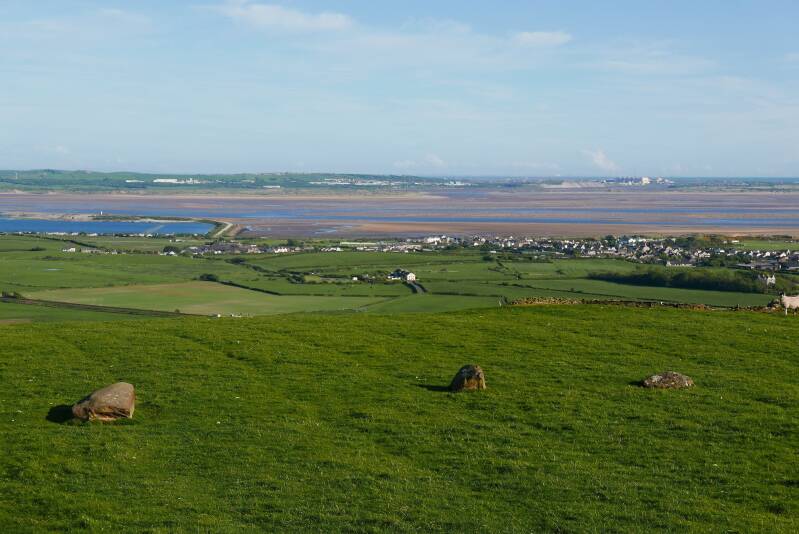
Photo below: the Lacra C stone circle, showing again how the stones at the circles at Lacra are of particular and uniquely different shapes. Behind can be seen the lowland around Milliom, and with the Duddon Estuary and Furness Peninsula beyond. The view visible in the photo below reminds me somewhat of that visible from Birkrigg Stone Circle, itself overlooking the Leven Estuary to the south of the Duddon Estuary. Lacra Bank, especially visible as in the photo below, is almost plateau-like in the way that it overlooks the surrounding landscape, and in a sense a world unto itself, perhaps being in some way a physical manifestation of ancient beliefs about the celestial realm. Perhaps this is also implied in the closeness that Lacra Bank has to Black Combe, both in terms of a literal closeness as well as the proximity that one feels to the mountain of Black Combe on Lacra Bank.
The ancient sites around Lacra deserve our respect and honour. So many of the ancient monuments on this coastline are threatened or have been destroyed, and I pray that no further damage ever comes of any of them. I hope also that the local people of West Cumbria continue to be able to reconnect to their past and that in doing so continue to make anew their ancient and sacred connection to this landscape.
For reference purposes this article's URL is: https://www.kielimatka-2-11.co.uk/c1-more-on-ancient-kirksanton-lacra-ancient-language-published-on-the-22-03-2026 . This article is dedicated to the ancestors of Kirksanton and Lacra in West Cumbria, and to the forces which drew me there. I hope that this article has been an interesting read.