On another possible archaeology site at Heaning Scout Wood
This article was written & published by Linden Alexander Pentecost & was published on the 13th of May 2026, no AI was used, this article was published in the UK and on this UK website,I the author am also from the UK. This article is unrelated to any and all of my other publications. This article also contains 4 photos taken by myself the author, this article contains 1098 words. The main text begins below and then continues after the photos and photo descriptions.
I have published many different things before detailing ancient historical sites around Carnforth and possible archaeological sites around Carnforth in Northern England. Here I would like to discuss a new archaeological site which was found by my mum recently. It is hard to say at this stage the type of archaeological site we are looking at, but in my opinion, the site could perhaps be a routeway of some kind that could have connected Summerhouse Hill (with its stone circle and other nearby ancient sites) to the sea via Heaning Scar Wood, the new archaeological site may have been a kind of processional way or track leading to or otherwise connected to Summerhouse Hill, or it could have existed for an entirely different purpose.
This trackway, if that's what it was, lies primarily within an open area within Heaning Scout Wood, and that this area is open may I think be important. My mum found two larger flint chippings or scrapers in this area, as well as various other small pieces of flint chippings. When I visited with her I discovered what may be a kind of dolman or primitive passage tomb, as well as a large erratic or moved limestone boulder within the centre of the open area, with grooves upon the top which may be natural or may have been channels for the flow of rainwater for example. This stone also somewhat resembles the head of an animal in its shape, but this is of course just my interpretation and I may be entirely incorrect.
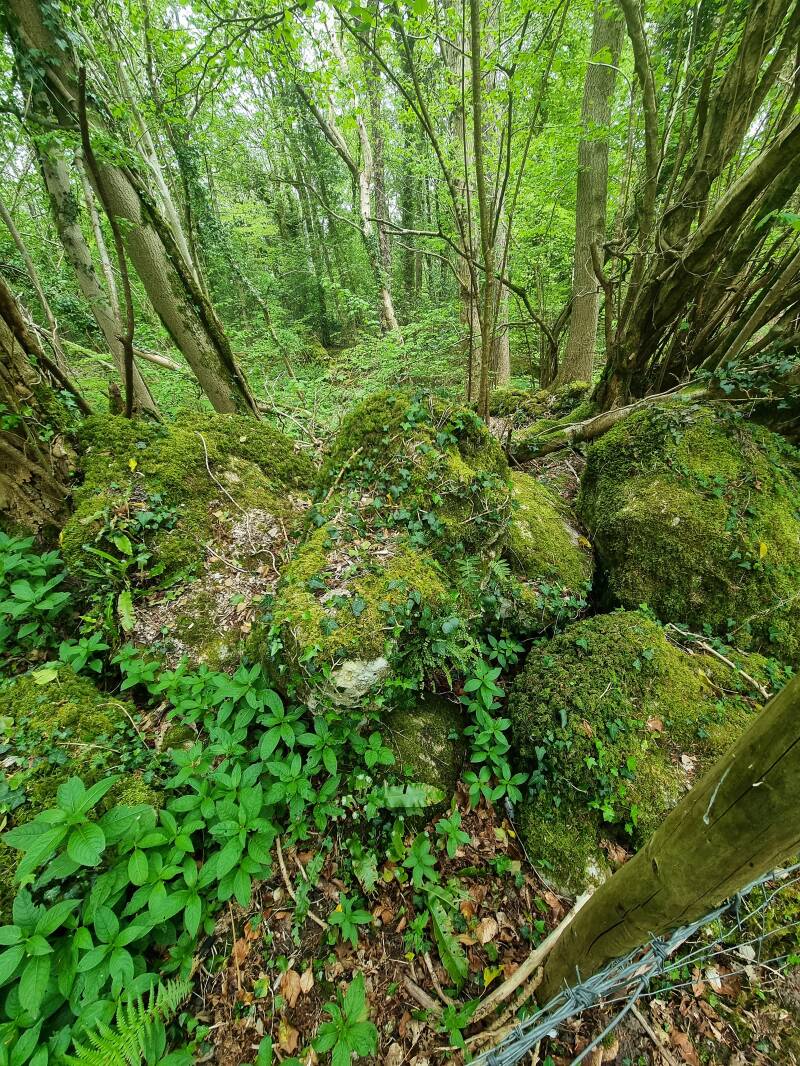
My mother also discovered on her first trip a flat stone propped into the limestone pavement at the edge of the site, but when she returned for the second visit, this propped stone had mysteriously been removed. Why might this have been? Especially considering there was barely a month between the two visits. This is another reason why it is incredibly important to record and document these sites. There are in addition walls that border the open area, some of which are more general drystone limestone walls, whilst others use much larger rocks and they look to me at least medieval or perhaps even earlier. Furthermore the track from this open area descends into the woods along a largely very straight route, which again might imply an ancient processional way.
There are numerous large boulders concentrated in parts of this forest, including on this trackway, but it is difficult to say whether or not some of these are perhaps aligned to the trackway. When I first touched the pieces of worked flint which my mum found, I remember having an unusual feeling as though a jolt of happiness and joyous spiritual energy suddenly glittered around me and in my world. Perhaps it was in part connected to how, apart from my mum, I was likely the first person to touch them in thousands of years, although of course the same can generally be said of the flints we find, although I have not experienced this sensation before. Considering that a stone placed into a limestone pavement at this site was recently destroyed or removed, when it could have been ancient, I hope that archaeologists do give this site some attention. If necessarily I will also be able to locate the flints again, but they were not taken off site and instead have been hidden on the site. I prefer this solution in this case because I am revealing the GPS coordinates of this site, which are: 54°09'31.6"N 2°45'53.6"W . Below are four photos, one showing the flints and three others showing various parts of this site, or possible site.
Photo below: two flint chippings, the largest found on the ground as exposed on the surfaces of molehills, these were the flints which gave me an unusual happy feeling.
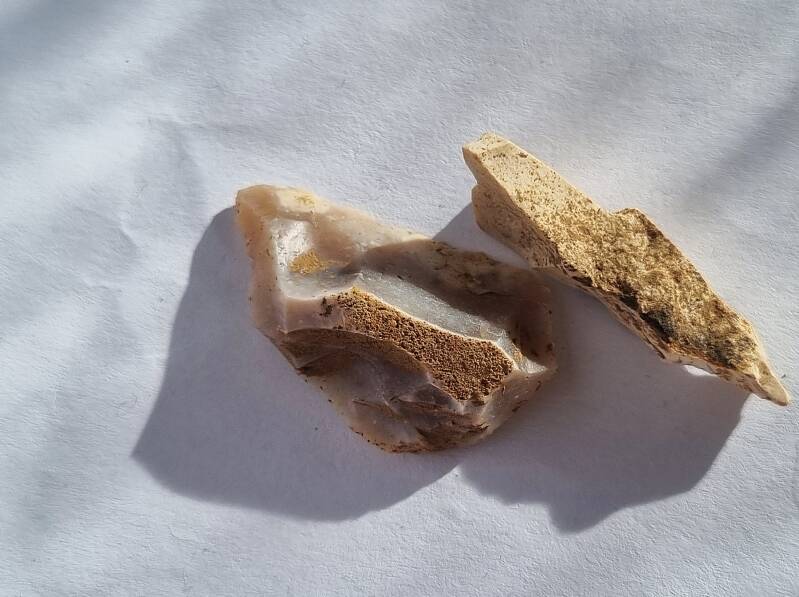
Photo below: the erratic or perhaps moved boulder at the centre of the open area, as viewed from behind, the boulders channels, possibly natural, and somewhat animal-like features are not visible in the photo below. Note how this boulder occupies a central part of the open area.
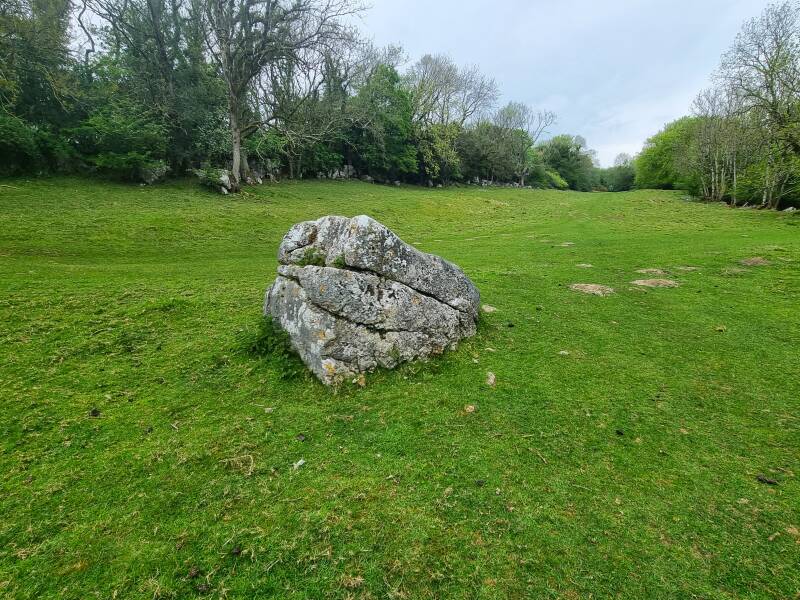
Photo below: the possible primitive dolmen or primitive passage tomb, note the-, what can be thought of as being a kind of capstone perhaps, centre image. This structure is built into a natural limestone cliff, a metre or more high, but boulders have clearly also been placed upon the natural outcrop, or moved there in some way, as well as the obvious "cap-stone" type boulder at the centre of the image below, beneath which is a space. If this is a dolmen or passage tomb type structure, then, like the rest of the site, I think it needs a kind of spiritual respect from us.
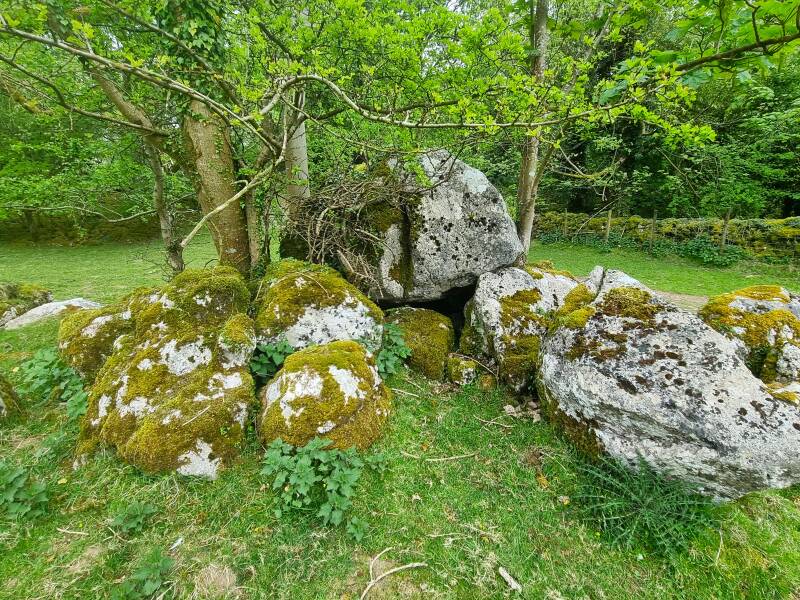
Photo below: a section of wall bordering a part of the open area, note the large boulders in the wall, which could be described as small megaliths.
Whilst many of the archaeological sites around Carnforth are poorly understood, and whilst many other possible sites are also extant, there is a lot more archaeological research to be done here, and of course it must be done in a way where landowners' permissions and other permissions are sought before any kind of excavation, and everything is done legally, furthermore I feel that in many respects this area does not want to give up its secrets yet. The megalithic sites, and possible megalithic sites of this area, are often hard to understand, and fit into no neat categories. Furthermore, the area is truly ancient, and I do think that perhaps the ancestors of this area do not want to reveal all their secrets yet. These forests and coastlines are quite wild, untouched, the ancestral cultures so strongly present and yet forgotten by most, but not gone, and deserving of our respect.
I hope that this article was an interesting read. It is dedicated to all those I love and in gratitude to them, and to the ancient ancestors of the Carnforth/North Lancashire/South Cumbria limestone areas, I am grateful to them too.