DS1: A new introduction to Northern Sámi; and connected topics, published on the 19/02/2026
Written and published by Linden Alexander Pentecost. Published on the 19th of February 2026.
This article was published in the UK, only on this website and the author lives in the UK and is from the UK. This article/chapter was completed and published on the 19th of February 2026. No AI is used in any of my writings. The photo in this chapter/article, showing some lávut near Kilpisjärvi, was also taken by me the author, and neither the text in this article nor the photo have been published before, nor is this publication the same as any of my other publications on Northern Sámi, nor does it contain the same information as them, and this publication on this page contains a lot of new information not in other publications, and my other publications also have different information not found in this publication.. Note that yesterday on the 19th of February 2026 I published an unrelated article on one of my other websites, the aforementioned other article was about different topics, and within the aforementioned article I also mention this new website you are currently on. Further on this web-page on this website in this chapter, I also reference other things pertaining to the aforementioned other website. This article on this page is the first chapter of these articles teaching the Northern Sámi language with new information, this chapter contains the following four sections (which do not include this section in small script), including below the contents below. The main content begins after the small script and at the first section with a roman numeral in its tital. This chapter contains 4 main sections, not including this first bit. This article or chapter on this page is also the first publication on this new website you are currently on. Note that the other website (which is only one of my other websites) upon which I published the article/blog post I mentioned as having published yesterday, is also not that old of a website, and that the first article published upon that aforementioned website also related to Northern Scandinavia and the Narvik area, albeit with very different linguistic information and topics to those in this article on this page. The aforementioned article on the other website is mentioned on this page later on and is titled, I will give the title here again: More on languages around Narvik & more on the Narvik dialect & other topics, published 25/11/2025 and is on the website titled www.languages-of-linnunrata.co.uk .The article you are currently on, on this webpage, is titled: DS1: Northern Sámi New introduction, spelling, sounds, phrases & connected topics, and is a page on the website you are currently on, which is: www.kielimatka-2-11.co.uk . The full web address of this page on www.kielimatka-2-11.co.uk is given near the end of this chapter. The titles of the sections below do not by any means hint at all the topics discussed in those sections. It is also noteworthy that the first article published on one of my other websites, titled www.clwaideac-na-cuinne.co.uk pertained to yet other aspects of language in Northern Scandinavia. Not all of my websites have been mentioned on this page. This article/chapter on this page you are on contains a total of 6343 words, making it one of my longest online HTML publications (if not the longest), (on a single webpage, not in an ebook or print book or magazine etc). This article also contains one photo. Some important edits were made a few hours after the initial publication and then some others were made on the 20th of February 2026, on the 20th of February 2026 I also published other, unrelated things on different websites to the one you are currently on. I will likely be publishing other things over the next few days on different websites. Another small edit was added on the 21st of February 2026, but there will be no more edits after this point.
I. An introduction to Northern Sámi & its background, and how I came to love the language, & a poem in English
II. A photo of lávut & description
III. Northern Sámi spelling & pronunciation & other notes, including on ancient and more recent etymologies, including those from Norwegian & Sámi taboo speech
IV. Northern Sámi phrases, grammar and information on Sámi drum symbolic language
The DS1: in the title of this chapter stands for davvisámegiella1 or Northern Sámi 1, the first chapter in this series of articles on Northern Sámi on this website. This chapter is titled including the words "new introduction" to distinguish it from different introductory publications, and more detailed publications, I have published previously introducing or generally discussing or relating to Northern Sámi, which all have different information to that given on this page on this website. This page on this website contains much that I have never published about before, including several entirely new topics related to Northern Sámi, including the later influence of other languages on Sámi languages, like Norwegian, a section on Sámi taboo speech, new etymology information and suggestions, ancient history, as well as a section on Sámi drum symbolic language (although I have briefly mentioned one such symbol in a different context, in another publication recently), but the subject of these symbols has far more, and new information relating to in this article. There are also lots of other completely new topics and information in this chapter, none of it is repeated from elsewhere, and all of the parts of this chapter or article present new information and points. This chapter also discusses aspects to Sámi culture, history and spirituality, and personal reasons for learning the language to some extent, as well as the linguistic stuff. I also discuss newly noticed possible Afro-Asiatic similarities a Northern Sámi word in this article, and many other new things pertaining to ancient history and language. The main sections of this chapter begin below:
I. An introduction to Northern Sámi & its background, and how I came to love the language, & a poem in English
Northern Sámi is one of my favourite languages, and is spoken in what I find to be one of the most magnificent, majestic and beautiful landscapes on Earth. Northern Sámi is an indigenous Uralic language of the Samic branch, spoken in parts of northern Norway, Sweden and Finland. The lands where this language is spoken correspond to much of what we in English call "Lapland", but the Sámi call their indigenous homelands Sápmi in the Northern Sámi language. There are also several other Sámi languages, which are spoken in other parts of this greater Sápmi region. Northern Sámi, known in Northern Sámi as Sámegiella or as Davvisámegiella has the largest number of speakers out of the Sámi languages, with the others being critically endangered, and two of them being sadly extinct.
Northern Sámi is known as Nordsamisk in Norwegian, as Nordsamiska in Swedish and as Pohjoissaame in Finnish. There are also several dialects of Northern Sámi itself, including the Western Finnmark Dialect, the Eastern Finnmark, which are spoken in western Finnmark and eastern Finnmark respectively, Finnmark being the northernmost county of mainland Northern Norway, where for example the towns of Alta, in Northern Sámi: Áltá, Kautokeino, in Northern Sámi: Guovdageaidnu and Karasjok, in Northern Sámi: Kárášjohka are located. Both the western and eastern Finnmark Northern Sámi dialects, are also spoken in adjoining areas of Northern Finland.
Many of the coastal areas of northernmost Norway have been historically inhabited by speakers of the Sea Sámi dialects, extending from the Vardø area in the east, towards close to Tromsø, in Northern Sámi: Romsa in the west. South of Tromsø and inland towards Eastern Troms and down towards Vesterålen (in Northern Sámi: Viestterálas), parts of Lofoten (in Northern Sámi: Lufuohttá) and Narvik (in Northern Sámi: Áhkanjárga), the Northern Sámi dialects were considered the Marka Northern Sámi dialects. Marka Northern Sámi dialects are sometimes considered a part of, or closely related to the Torne Northern Sámi dialects, which in their core zone (not including the Marka Northern Sámi areas) are spoken in parts of Northern Sweden, east and south of Narvik, and into the northwestern corner of Finland, which includes the area around Kilpisjärvi, or in Northern Sámi: Gilbbesjávri. There is a photo of some lávut at Gilbbesjávri and a photo description above in the next part of this chapter.
As well as Northern Sámi, there are other indigenous languages spoken in the region of where Northern Sámi is spoken, including the Meänkieli, Lannankieli, Kven and Northern Finnish languages. I personally also believe that the Northern Norwegian dialects spoken in this region have ancient roots in some parts of Northern Norway, and other languages have also gone extinct in this region in the past I believe, but nevertheless, Northern Sámi is the most widely spoken indigenous language in that rather large region, and I believe that its roots there go back a very long way. Speakers of Northern Sámi have historically and since ancient times practised spiritual beliefs and systems which can be described as both animistic and shamanic. The Northern Sámi word for the Sámi equivalent of a shaman is called a noaidi. Certain types of sacred Sámi sites are referred to as a sieidi in Northern Sámi, these sites are often mysterious rock formations or hills, one of which, at Báddosdievvá, I discussed recently in a blog post on one of my other websites . The sieidi sites are very sacred and powerful, and are sadly not always given the respect and understanding that they deserve. Another imposing sieidi site is the Lapphaugen sieidi near Fossbakken in Troms.
Northern Sámi has historically been spoken across a wide variety of landscapes, from the tundra-like uplands and low birch forests of Finnmark, to the dense evergreen forests of Northern Finland and Northern Sweden, to the green and lush mountains of parts of Troms, Nordland, and around the estuaries of the Alta and Tana Rivers, to the barren, desert-like landscapes of the Varanger Peninsula, to the lush and misty islands off Troms and Finnmark. I am uncertain as to why Northern Sámi is spoken across such a wide area, but I suppose that the Sámi people in this area, and other ancestral groups and languages may have shared close relationships in the Northern Sámi language region, going back many thousands of years. Many examples of the petroglyphs in that region also depict reindeer and boats, which in many ways correspond to different aspects of Northern Sámi language and culture today, and I personally tend to think of the reindeer petroglyphs for example as being deeply representative of ancient Sámi spirituality and culture. One example of such a carving can be found at Brennholtet in Narvik, Áhkanjárga. I hope to discuss this petroglyph in an unrelated, different article on this website (this website that the page in front of you is also on) in the near future. For some other information about languages around Narvik, please see my other works, including my article published on a different website (not the website you are currently on), the article on the other website (one of my other websites) being titled: More on languages around Narvik & more on the Narvik dialect & other topics, published 25/11/2025. The aforementioned website (not the website you are currenty on) is also where my blog post about Báddosdievvá is published, and I publish on other further websites and other places also. Below are some other place-names with their Northern Sámi equivalents:
Hammerfest - Hámmárfeasta
Vardø - Várggát
The Tana River - Deatnu
Utsjoki - Ohcejohka
Kiruna - Giron
Bardufoss - Beardogorži
Senja (island) - Sážžá
Ringvassøya (island) - Ráneš
Vanna (island) - Várdná
Personally, I became interested in this language when I was around 16, and learned bits and pieces of it. Two years later when I visited Sápmi for the first time, I completely fell in love with the landscape, and with its ancient traditions, peoples and nature. Although I have always held Northern Sámi in my heart, and have written on it before extensively, I also extensively researched and published about other aspects of language in Northern Scandinavia to a large extent, and it's only recently that I've realised that I wish in the future to dedicate a lot of that energy specifically towards speaking better Northern Sámi and to publishing about it, which is partially why I created this new website which this page is on. Below is a poem in English which I wrote about the Northern Sámi language. I have also not published the poem below until now:
Language of birch, and of northern shores
Of eternal skies, reborn again yet also so old
Where the birds speak an ancient song
Their calls speak in the Northern Sámi tongue
Like the voices of rivers and of holy beings
Guarding the north, over mountain and sea
Mountains where reindeer snort, and where by rocky shores grows long grass
Your forests of colour and light, and the jojking of sacred root words
Are such a beautiful thing upon this world
For me in many senses, the Northern Sámi language feels connected to the birch-forested regions of the far north, to the closeness of the forest and to all of its beautiful nature. The poem above also refers to how some names in the Northern Sámi language reflect the forest itself and its wildlife, and the spiritual reality of that wildlife.
II. A photo of lávut & description
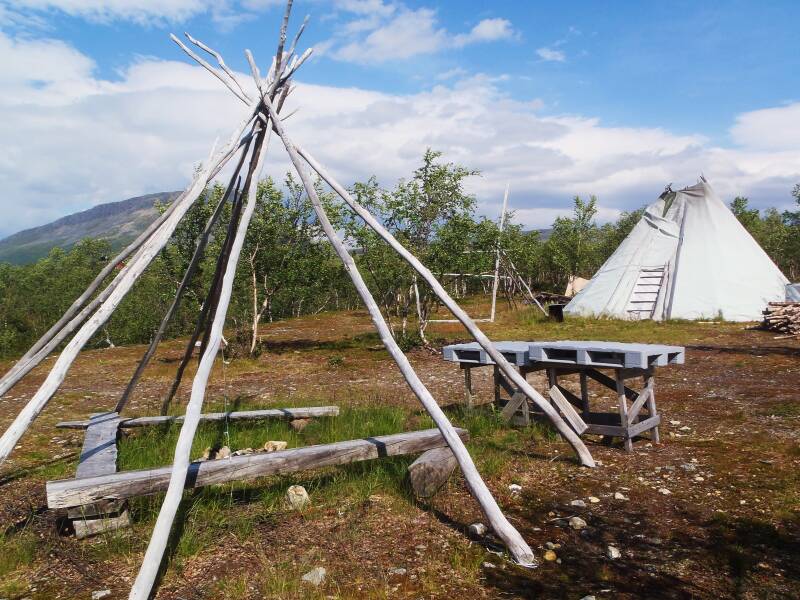
Photo below: Sámi lavvus on the dry summer ground, in a birch forest of small trees, with the great mountain Saana behind, Saana is the Finnish name for the mountain, in Northern Sámi it is known as Sána. The mountain is very sacred and prominent, and is a sacred mountain to the Sámi. The lavvus in the foreground, the name of which comes from Northern Sámi lávvu, are the dwelling structures visible in the photo below, somewhat akin to tepees as used by certain indigenous American tribes. They are constructed from trees, with reindeer hide then being traditionally placed over the wooden frame. This site is located close to the village and lake of Kilpisjärvi in Northern Finland, that being the Finnish name, the Northern Sámi name for the lake is Gilbbesjávri. This place is quite profound, and when I visited these lávut in the photo below, when I was 18, it was the first time in my whole life that I had ever been close to a modern indigenous dwelling structure, this is however not counting ancient structures I had been to before. In many senses the lávut reflect similar traditions and building styles found in many parts of the Northern Hemisphere.
III. Northern Sámi spelling & pronunciation & other notes, including on ancient and more recent etymologies, including those from Norwegian & Sámi taboo speech
The Northern Sámi alphabet contains the letters shown in this section, after which is discussed the pronunciation of each letter in detail, after which are some more long paragraphs and information before the beginning of the next section regarding phonology and vocabulary and other points. Note that not all details of Northern Sámi pronunciation are discussed in this chapter, and this chapter also does not talk about differences in the different dialects of Northern Sámi in much phonetic detail. These details will be covered in later chapters. Nevertheless I hope that the introduction below is thorough. The phonology of Northern Sámi, particularly of the consonants, is really quite complex, and the descriptions below do not explain every detail, and in addition, the way in which Northern Sámi phonology is defined also depends to some degree on the linguist and description, but what is written below is accurate I am confident. Over the decades, Northern Sámi orthography has also changed several times, and Northern Sámi spelling can be very different to that of some other Sámi languages. The alphabet is as follows, followed by more detailed descriptions of each letter:
Aa Áá Bb Cc Čč Dd Đđ Ee Ff Gg Hh Ii Jj Kk Ll Mm Nn Ŋŋ Oo Pp Rr Ss Šš Tt Ŧŧ Uu Vv Zz Žž
Aa - sounds like the "a" in English, a level pure "a" sound, IPA: [a], e.g. albbas - "lynx", and albmi - "sky"
Áá - sounds like a longer version of the above vowel, or approaches a long or short version of the [æ] sound in the word "cat", e.g. áigi - "time" and árpu - "thread"
Bb - the Northern Sámi b is generally an unaspirated [p] sound, similar to the "p" in the English word "spin", e.g. boazu - "reindeer", boahtit - "to come", beaivi - "sun" or "day". In the combinations bb and mb the Northern Sámi letter b is pronounced closer to an English "b" as in "bat", e.g. in the name Gilbbesjávri - Kilpisjärvi.
Cc - is pronounced like the "ts" in the English word "sits", IPA: [ts] e.g. cuoppu - "frog", and ceavvi - "dense snow". In the middle of a word, the c often takes pre-aspiration, or a "h" sound before the consonant, IPA: [hts].
Čč - is pronounced like the English "ch" in "chess", IPA: [tʃ], e.g. čoalbmi - "a strait" (water), čáhci - "water", čalmbi - "eye", in certain situations in the middle of a word, this letter takes pre-aspiration, IPA: [htʃ].
Dd - pronounced like an unaspirated English 't' as in the English word "stir", IPA: [t], e.g. dárogiella - Norwegian or Swedish language, dállu - "house", duorga - "twig", dievvá - "a small hill/mound", in the combinations dd and dn it is pronounced closer to the English voiced "d" sound, IPA: [d].
Đđ - is pronounced like the "th" sound in the English word "this", IPA: [ð], this sound does not occur at the start of a word in Northern Sámi, but occurs medially, e.g. buođđu - "a dam", and dieđán - "I know". -
Ee - a pure "e" sound, similar to the French é, IPA: [e] or [eː], at the start of a word e usually occurs as part of the vowel combination ea- , e.g. eatnu - "main river", earráset - "others", eanet - "more".
Ff - pronounced like the English "f", IPA: [f], e.g. fábmu - "power, strength", fanas - "boat".
Gg - generally pronounced as an unaspirated English [k] as in the word "scarf", IPA: [k], e.g. guolli - "a fish", giella - "language", guovža - "bear", in the combination gg the letter g is pronounced closer to the "g" in the English word "gate".
Hh - pronounced similarly to the h in English, IPA: [h], e.g. hállat - "to speak", háia - "a shark", this letter in Northern Sámi also marks pre-aspiration but does not always mark pre-aspiration, e.g. the first h in the word oahppaheaddji - "teacher".
Ii - pronounced as a pure "ee" sound, similar to in the English word "seen", IPA [i], can either be long or short, e.g. ipmirdit - "to understand", and iđit - "a morning".
Jj - pronounced like the semivowel "y" in the English word "yes", or like the "j" in the German word ja - yes, e.g. johka - "river", jeagil - "lichen", juoksa - "bow".
Kk - an aspirated "k" sound, like the English "k" in "kin", in the middle of a word (not initially) the k is often pre-aspirated and takes a "h" sound before it, it generally only occurs at the beginning of a word in loanwords.
Ll - similar to the English "l", IPA: [l], examples: lávvu - a traditional tipi-like Sámi dwelling, and luokta - "bay".
Mm - as in the English letter "m", IPA: [m], e.g. mátki - "a travel", muorra - "a tree", mánnu - "a moon" or "month", meahcci - "wilderness".
Nn - as in the English letter "n", IPA: [n], e.g. njižži - "a breast", njeallje - "four", and násti - "star".
Ŋŋ - like the "ng" in the English word "sing", IPA: [ŋ], does not occur at the start of a word, examples: čeŋkkes - "the little finger", and gaigŋir - "the elbow".
Oo - like the English "o" in "no", IPA: [o] or [oː], e.g. oahppaheaddji - "teacher", oahci - "sandbar", oarji - "west" etc.
Pp - like the aspirated English "p" sound in "pin", in the middle of a word this sound occurs also with pre-aspiraton, normally occurs at the beginning of a word only in loanwords, but is pronounced aspirated at the start of a stressed syllable
Rr - a rolled or trilled "r" sound similar to that in Spanish and in Finnish, IPA: [r], to what degree this sound is rolled depends on the dialect and speaker of Northern Sámi, e.g. raŧŧi - "a winter road", ráfi - "peace", ruohtta - "eve" and ráššu "a cold rain".
Ss - like the English "s" in "sound", e.g. suolu - "island", soahki - "birch tree", sarva - "a moose", skurču - "canyon".
Šš - like the English "sh" in "ship", IPA: [ʃ], e.g. šaddu - "a plant", and duoršu - "mallard duck".
Tt - an aspirated English 't' sound as in English "tip", also occurs with pre-aspiration in certain positions, similarly to Northern Sámi k and p.
Ŧŧ - is a rare sound in Northern Sámi, which sounds like the voiceless "th" sound in the English word "thin", e.g. raŧŧi - "a winter road", and Ruoŧŧa - "Sweden" and Ruoŧagiella - "Swedish language"
Vv - at the beginning of a word, like the English "v", e.g. vađđa - "an open area in the middle of a forest", várri - "a mountain", etc. In certain positions after a vowel it sounds more similar to [w], [u] or [β], e.g. in the word járvi - "lake".
Zz - pronounced like the Northern Sámi letter c but when it is doubled as zz it is pronounced closer to "dz", IPA: [d͡z], does not generally occur at the start of a word, occurs for example in: sávza - "sheep".
Žž - pronounced similarly to the Northern Sámi č, but pronounced as [t͡ʃ], the double form žž is pronounced like the English 'j' in 'Jack', IPA: [d͡ʒ],. Examples include: lávži - "a strap", and čuovža - "a whitefish".
One of the reasons that Northern Sámi phonology is quite complex, is the way in which differences in consonant length, aspiration, pre-aspiration and voicelessness can vary between consonants. Some of these differences. The consonants pertaining to the last syllable on a Northern Sámi word can also vary due to "consonant gradation", a process somewhat akin to the initial consonant mutation processes found in Celtic languages. I will talk more about Northern Sámi consonant gradation in future chapters. The prosody of Northern Sámi can also vary quite a bit from place to place. The way in which the Northern Sámi rapper and musician Áilu Valle from near Lake Inari in Finland for example, sings Northern Sámi with a prosodic structure that is to me closer to that of Inari Sámi. The dialects of western Finnmark by contrast, for example, have to me a more musical prosody, although not like that found in the Nordic languages. The pre-aspiration in Sámi languages does I think originate in ancient language influences, and it is also found in some Nordic languages and in many forms of Scottish Gaelic for example. Whilst pre-aspiration is usually written in Northern Sámi, it can also occur in positions where it is not written. I will discuss this more in future chapters.
Whilst the majority of Northern Sámi words can be traced back to a common Sámi or proto-Samic form, some root words are only found in certain Sámi languages or languages, and generally, many of the root words present within Sámi languages cannot be traced or connected to a hypothetical Proto-Uralic form. These words of mysterious origin are often described as being substrate words, but, whilst I think it is true that these words may well connect to other ancient languages in the region of the Northern Sámi language, it is also possible I think that the Sámi languages are much more ancient than is commonly believed. The Sámi way of life has been generally peaceful, and has been in tune with nature, and in my opinion, very holy. The common vocabulary of Sámi languages can be seen for example in how the Northern Sámi word soahki, a word of mysterious origin, appears in other Sámi languages, for example, in Skolt Sámi as: suẹʹǩǩ, in Inari Sámi as: suáhi, in Lule Sámi as: soahke, and in Southern Sámi as: såekie. This word represents an example of a common Sámi root word, shared throughout the ancient landscapes of Sápmi, but which is not found in other Uralic languages, and likely represents a very ancient root word. Several of the other words mentioned in the descriptions of Northern Sámi sounds earlier in this section are also of uncertain and likely extra-Uralic (or pre-Uralic) origin. I have discussed many others elsewhere. Another example I will mention here is Northern Sámi duorga - "twig", a word which, interestingly, shows some similarity to several Proto-Afro-Asiatic root words meaning "stick". I have commented in other publications on other possible links between Sámi and Afro-Asiatic languages, but this new possible word connection is I think important. I personally think that duorga can perhaps be connected to Proto-Afro-Asiatic *taḳar- - "stick, pole" (1), and to Proto-Afro-Asiatic *tawar-/*tayar- "pole, stick" (1), source (1) being the Afro-Asiatic vocabulary as reconstructed by Alexander Militarev and Olga Stolbova, this is vocabulary I discussed in other ways very extensively elsewhere, and is available on the starling.db. website.
Another aspect to this which I have not discussed elsewhere, like many things in this article, is the presence of strange "field" and "ditch" formations in mainly more southern parts of Swedish and Finnish Sápmi. I have heard before that these vast systems visible on maps were created for planting potatoes, and that they are glacial in origin, but in fact I think they are in some way more mysterious. This is another suggestion, like the presence of many other ancient and sacred sites in Sápmi, that this landscape may have some kind of deep, archaeological and megalithic history, which is beyond our current understanding. If these ditch and field formations in parts of Sápmi are indeed made by ancestral cultures, then it would further imply that at one time, that part of the world was perhaps inhabited by ancestral cultures that we know very little about. The precise way in which the Sámi languages connect to the Finnic languages in the aforementioned area is also a confusing and debated subject, which I have discussed in some places elsewhere. I also am aware of some sacred ancient sites near Muonio in Finland for example, and whilst these sites are no doubt connected to the Sámi, the other cultures perhaps connected to these sites might be more mysterious. One such sieidi in the Muonio area is known as Kirkkopahta, whilst another is known as Porviniemi. These sieidi sites lie in the area which is Northern Finnish speaking, but which in the past likely spoke a form of Northern Sámi or a form of the Kemi Sámi language, although Kemi Sámi itself seems to me to occupy a mysterious linguistic region between Finnic and Sámi languages, which might be some indicator of another ancestral culture present in this area. Another sieidi site near Muonio at Äkässaivo has a carved stone head. I have discussed other aspects to stone heads and to Muonio and Finnish and Sámi in other publications, but not with regard to the details discussed here. Perhaps the Northern Sámi language is in some way fundamental to connecting the Eastern and Western Sámi languages to this more southern area, to Kemi Sámi, Finnic and to other possible ancient languages. I do feel that this is in a sense suggested by the distribution of the Northern Sámi language, and how it seems to flank other Sámi languages, as well as many Finnic languages. Perhaps the distribution of Northern Sámi and that of Lannankieli, Meänkieli, Kven and Northern Finnish, relates to ancient points of connection and to the shared linguistic ancestry which connects these languages to other ancient cultures. I have not discussed this exact thing before.
In more recent times, Sámi languages have borrowed a fair amount of vocabulary from Norwegian, Swedish, and to a lesser extent from Finnish. In the next section I mention a couple of words which "may" have been borrowed from Finnish, but which likely I think represent older common words. Generally, the more recent borrowings into Sámi languages are for concepts which did not exist historically in Sámi society, words for modern things, which quite frequently have Greek and Latin roots, despite being borrowed via Norwegian or Swedish. Examples include: ekologiija - "ecology", fabrihkka - "factory", and feminisma - "feminism", which is not to imply that women were treated unfairly before the concept of feminism arrived in the north, just that this concept was not named in the same way until the word feminisma was adopted from Norwegian into Northern Sámi. The word fabrihkka is in a sense representative of how industrial society has also reached Sápmi, and whilst I do not dislike the word fabrihkka, I very much feel sad about the immense environmental damage which has happened, and which continues to happen in Sápmi to this day. I sincerely pray that the law will change to completely and utterly ban large scale mining in Sápmi.
Like for example Finnish and Scottish Gaelic, and like many indigenous American languages, Northern Sámi speakers historically considered certain words to possess the power to "call" the attention of the thing they were naming. This is why for example the word guovža was not always directly used to refer to a bear, as it was believed that saying this word could invoke its power in a dangerous way, particularly dangerous for example when hunting. The bear in Northern Sámi would also be referred to for example as meahcehas - "the one living in the forest", among other special descriptive names, which I believe gave the speaker the ability to refer to the bear by an honorary title, without using its "name" in Northern Sámi. I suspect that other animals may have also had honorary names in Northern Sámi, but I have found no examples of similar descriptive terms to avoid calling other animals by their real names. In a more general sense, the Northern Sámi language, and its magical songs and ritual uses of language, interfaces with the spiritual and natural worlds through specific ritual processes and meanings, many of which are not widely discussed in studies of the language. In the Finnish language, a similar taboo historically exists around avoiding the use of the primary word for "bear", which is karhu. In a wider sense, this seems related to an ancient system of European beliefs that understood the bear as being central to nature and to the natural environment, in many ways implying the bear as having been the "king" or "queen" of the forest in a sense. The "jojk" is another form of sacred language connected to the Northern Sámi language, the verb "to joik" in Northern Sámi being juoigat.
IV. Northern Sámi phrases, grammar and information on Sámi drum symbolic language
Below are 16 phrases in Northern Sámi followed by their English equivalents. After the phrases there are some notes explaining the individual word meanings and some notes on grammar. Some of the words shown in the phrases and below show a close similarity to Finnish words, and perhaps through borrowing or sprachbund influence rather than through common Uralic etymologies, for example Northern Sámi andagassi and Northern Sámi giitu are both similar to the equivalent Finnish words, which in Finnish are: anteeksi and kiitos. Note that in the examples below, a final -t is often pronounced [h]. The use of certain sayings and words can also depend on the individual dialect of Northern Sámi.
mii du namma lea? - what is your name?
mu namma lea... - my name is...
gos don orut? - where do you live?
mun orun.... -s - I live in...
mo manná? - how's it going?/how are you?
dat manná bures - it goes well/I am well
giitu - thank you
andagassii - excuse me, sorry
buorre iđit - good morning
buorre beaivi - good day
buorre eahket - good evening
buorre idja - good night
mana dearvan - goodbye (to one person)
hálatgo davvisámegiela? - do you (singular) speak Northern Sámi?
mun in hála davvisámegiela - I do not speak Northern Sámi
mun hálan davvisámegiela - I speak Northern Sámi
Word meanings:
mii - what, du - thy (your singular), namma - "name", lea - "is", mu - "my", gos - where? (in where), don - you (singular), orut - "you (singular) live", mun - "I", orun - "I live", ...-s - locative singular ending of nouns, mo - "how", manná - "goes", dat - "it", bures - well, good, giitu - "thankyou, thanks", andagassii - "excuse me", buorre - "good", iđit - "morning", beaivi - "day" or "sun", eahket - "evening", idja - "night", mana - second person singular imperative of mannat - "to go", dearvan - "well, safely", hálatgo - "do you (singular) speak?", davvisámegiela - accusative-genitive form of davvisámegiella - "Northern Sámi language", mun in - "I not" (first person singular negative verb form), mun in hála - "I do not speak", mun hálan - "I speak".
Notes:
The locative case is a form that nouns take in Northern Sámi for saying that something is in or in the location of that noun. In English we use the preposition "in" instead. For example Romsa - Tromsø, but don orut Romssas - "you (singular) live in Tromsø.
In Northern Sámi questions are frequently formed by adding the suffix -go onto a verb, e.g. hálat - "you (singular) speak", and hálatgo? - "do you (singular) speak?"
Northern Sámi, like Finnish for example, has a "negative verb", which means that in the negative form of a sentence, the negative particle takes the pronoun ending, rather than the verb itself. In the sentence mun hálan davvisámegiela, the pronoun for "I" is mun, and the "doer" of the verb is also indicated on the end of the verb as the -n in hálan, which without the pronoun before it can also mean "I speak". In the negative form of this sentence, the -n which indicates the pronoun verb ending on the verb, is removed from the verb and instead attached onto the negative particle ii, the first person form of which is in, thus giving us mun in hála - "I do not speak". Similarly, if one wanted to say "you do not speak Northern Sámi", we take again the ending on the verb hálat meaning "you (singular) speak", and attach it onto the end of the negative particle ii, thus: don hálat davvisámegiela - "you (singular) speak Northern Sámi", and don it hála davvisámegiela - "you (singular) do not speak Northern Sámi".
Northern Sámi word order tends to be SVO or subject-verb-object order, although the precise way that this general pattern is expressed in Northern Sámi is different to how it presents itself in English and Norwegian for example, which are also, generally, but not always, SVO languages. The sentence order in Northern Sámi can also vary, whilst in Southern Sámi for example the general word order tends to be the SOV or subject-object-verb order, which is also a common word order in many other Uralic languages, but is not general in the Sámi nor in the Finnic languages. I think that some of these aspects related to word order may also depend on very ancient sprachbund influences.
Another very interesting aspect to the Northern Sámi language and to the culture of its speakers, is the presence of a kind of symbolic language, which is present on Sámi noaidi drums. From what I understand, this symbolic language can be quite hard to interpret, but I think that it can be thought of as a language. It is not an alphabetical written language which corresponds to Northern Sámi. This symbolic language includes images of boats, animals, people, symbolic representations of geography and direction, as well as symbolic representations of Sámi gods. Further information is incorporated into this symbolic language in terms of how these symbols are orientated and positioned on a particular noaidi drum. In some respects this magic symbolic language can resemble the holy stave symbolic language, a variant of which can be found in Iceland for instance, which I have discussed elsewhere. In another publication recently, I mentioned and described the symbol of the Sámi god Horagalles. I personally have a Sámi object, likely one sold as a souvenir, made of reindeer bone, which someone got for me from an auction. I have also discussed this object before in other ways, and it also has upon it some of these symbols, although I can only interpret the ones which represent reindeer, and I also do not know the meaning of the symbols as a whole. Nevertheless I am very fond on this, what is to me, a sacred object, and I feel that it is a positive thing. In terms of the reindeer in this symbolic language, this also arguably harks back to the symbolic language of certain ancestral petroglyphs which depict reindeer or elk, such as that at Brennholtet in Narvik.
For reference, this chapter's URL is: https://www.kielimatka-2-11.co.uk/on-the-northern-sami-language-chapters-ds1-to-ds16/ds1-a-new-introduction-to-northern-sami-and-connected-topics-published-on-the-19-02-2026 .
In part two of this course on Northern Sámi, I will be discussing more nouns and how some of the declinations work, with some example sentences, and with some information about Sámi spiritual beliefs. This chapter is dedicated to the speakers of the Northern Sámi language in general, and to their ancestors and spiritual guardians, and to all I love. Many of the future chapters will be somewhat shorter than the one on this page.