B1: More on Barra Isles language & on the Pabbay Pictish symbol stone, published on the 15/03/2026
Written and published by Linden Alexander Pentecost, published only on this website and on the 15th of March 2026, this article on this page is unrelated to and separate from any and all of my other publications, including from those where I discuss topics related to those herein. The two photos were also taken by myself the author, one of which is a photo of the Pabbay Pictish symbol stone drawing which I have done, showing the symbols, the other of which shows Pabbay from Vatersay. No AI was used in this article nor in any of my written works, this article was published in the UK, and I the author am from the UK and am a resident of the UK. This article contains 2283 words, the photo descriptions in italics contain information not in the main text, not the photos nor any part of this article have been published before. Note that this article also covers many topics in relation to the main topics, and much information, which is not indicated in the title of this article.
The Barra Isles are the southernmost group of islands in the Outer Hebrides. These islands abound in sacred sites and in ancient history, and have historically been Gaelic-speaking. Today, many still speak Gaelic on the islands of Vatersay and Barra, but the number of people who speak the local Barra and Vatersay dialects of Gaelic is now fewer. Islands like Pabbay, Sandray, Barra Head and Hellisay likely had their own variants of Gaelic, which most likely would have corresponded significantly to the dialects of Vatersay, Barra and perhaps Eriskay, in the case of Hellisay.
Other languages were spoken on the Barra Isles in the past. There is a notion that a P-Celtic language identified as “Pictish” was once spoken over all of Scotland, but there is no evidence for such a language on the Barra Isles. But, there would have been ancient language influences, which in my opinion can be identified within the Gaelic dialects, place-names and localised vocabulary etc. These earlier languages could well have been pre-Indo-European languages, and the island of Gighay, in Gaelic: Gioghay is an example of an island name near Barra, which may take its root *giogh- from an earlier language. This root also seems to appear in the name of the island Gigha or in Gaelic Giogha off the coast of Kintyre. This is also interesting given that the MacNeill clan also exists on Kintyre, Colonsay and Gigha, as well as Barra, so perhaps the root *giogh- is in some way connected to the ancestors of the MacNeills. What is also interesting with this is that, there is some similarity between the types of standing stones found on Barra and those found around parts of Kintyre and Colonsay and roughly in the traditional MacNeill areas of Argyll; although the distribution of these types of standing stones does not exactly match that of the MacNeills, and of course we are talking of standing stones that were erected thousands of years before the MacNeills as we know came into written history. As I have written elsewhere in different contexts, I sometimes think think of these certain standing stones in questions as being guardians. I feel they are connected in some way, I now believe, to the divine ancestors of the MacNeills. This is at least how I like to think of it.
Identifying these possible ancient languages with ancient cultures is also difficult, but I have written about other aspects of this extensively elsewhere, including and particularly in relation to Barra. There were Norse connections to the Barra Isles too, although many of these Norse-names show pre-Norse features, making it hard to say to what extent these names came from the Vikings, and to what extent they came from earlier languages, but were shared into Norse and Gaelic.
Whilst there is no evidence for a P-Celtic language on the Barra Isles, there is a Pictish symbol stone on the island of Pabbay, and this shows us an example of a form of symbolic language used by the people we identify as “Picts”. This does not mean to say that the Picts were necessarily present on Pabbay in the strictest sense, because the use of this symbolic language does not alone tell us that the people on Pabbay were culturally and linguistically the same as those in central Eastern Scotland, for example.
The Gaelic language on the Barra Isles preserves I think the greatest extent of these islands’ linguistic and ancestral history. Whilst there has been a commonly accepted theory that Gaelic came to Scotland as a part of the medieval kingdom of Dál Riada, I personally think that the Gaelic language and its dialects were already present as Celtic languages in Scotland far before this period, and I also think that the earlier, possibly pre-Indo-European languages, whilst remaining distinct from Gaelic, also lent themselves greatly to the phonetics, grammar and vocabulary of the Gaelic language, and I think it likely that the Gaelic spoken on Barra for example in part lends itself to the ancestral, pre-Celtic cultures who have been historically present on the island.
Barra and the Barra Isles have many sacred sites and ancient traditions. Even after the establishment of Christianity, the Gaels have always placed great respect and significance upon the burial places and sacred worship sites of the ancestors. People on the islands today still possess this relationship and understanding, even if this is not directly spoken, these ancient places and ancestors are still privately believed in and acknowledged, even if this is not made obvious on the surface per-se. This is in part because the beliefs have not been taken seriously, and that the narrative has often been written by people who didn’t truly understand this relationship.
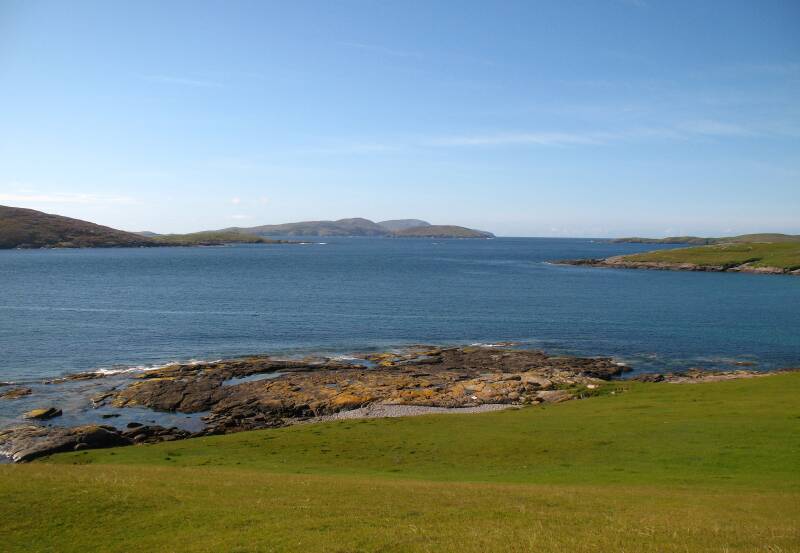
Photo below: a view south from Vatersay/Bhatarsaigh with the island of Sandray/Sanndraigh visible to the left, and the islands of Lingeigh and Pabbay/Pabaigh beyond at the centre of the image. This group of islands south of Barra truly invoke a lot of mystery, and it is sad I think that many of them used to be inhabited but are now no-longer inhabited. The Mingulay Boat Song is a well-known folk ballad about the island of Mingulay/Miughalaigh which is also one of this small group of islands to the south of Vatersay. It is I think easy to understand why the sacred island of Pabbay/Pabaigh was considered such a special place.
In a sense, the lack of acknowledgement for the wholeness of Gaelic culture is in part what leads to the language’s demise. Gaelic in my opinion needs the space to breathe and to live in a context that truly embraces the land, ancestors and lands of ancient Scotland. Simply reviving the language and turning it into another academic subject does not achieve this. Again - the language has to breathe, to live, as it always has.
The island of Pabbay/Pabaigh means literally something like "Priest Island", and refers to the people known as the Papar, often described as being Christian monks who sought isolated islands to gain a closeness to God. The truth is I think a bit more complex, considering that many facets of the Papars' culture and language - from my research, are not necessarily Christian. This does not mean that the Papar did not later come to embody the Christian faith, but certainly from my research, their language, culture, and even their lifestyle - which in some ways not being unfamiliar in terms of Christian traditions, do not come from Christian traditions. These Papar on Pabaigh must have been those who carved the Pabbay Pictish Symbol Stone, and whilst these symbol stones are very often associated with a Christian context, they are not Christian in origin, in my opinion. Even the cross symbol visible on the Pabbay Pictish Symbol Stone may be a Christian addition, but such cross shapes are also found in pre-Christian contexts. The Papar are very mysterious, and I do not think them the same culture as the people we identify as being "Pictish" and having used similar symbolic language in Eastern Scotland, and who are associated with an in-some-ways P-Celtic-like language. The fact that it seems to be the Papar who used this symbolic language in the Hebrides, is I think significant though.
Rather than thinking that the Papar on Pabaigh are Christian monks who settled there, I am more inclined to think of their presence of Pabaigh in terms of a more long term and continual context. There was an Iron Age settlement on Pabaigh before the hermitage of the Papar as we identify it in a medieval Christian context, of which the Pabbay Pictish Symbol Stone is also assumed to be a part of. So the Papar could in part go back to the Iron Age. Due also to that Pabaigh is not exactly easy to get to, there being no official boat or anything, and with the sounds between the islands south of Vatersay being dangerous, even for skilled seafolk - there is further possibility that the Papar or at least, their ancestors, were present on Pabaigh during an earlier time too.
In the photo description below, I explain more about the Pabbay Pictish Symbol Stone, and below the photo description below is a drawing of the Pabbay Pictish Symbol Stone. I have not been there myself, not to Pabbay itself, so I drew the stone and its symbols based on old drawings and depictions I have seen, some of the details are hard to read also and I have omitted certain things visible on other drawings and in photos because I am not sure if they are part of the carvings or not.
Photo below: a drawing of the Pabbay Pictish Symbol Stone, with the different symbols pointed out with numbered arrows around the stone; 1. points to the cross symbol, which is not necessarily a Christian cross, but which could also have been added later, 2. points to a nice and unique example of a V-Rod combined with Crescent Symbol, 3. points to a less common Pictish symbol, which has been interpreted by some as being a flower, but I am not sure if this is quite what this represents - and this symbol and more on the particular symbols on this stone are a subject I will discuss again in a different article with further information in a future writing I intend to publish somewhere, the 4. on the image below points to a mysterious, often smaller Pictish symbol, which to me looks like bird wings. It also appears on some other Pictish stones too, but it seems to not be commonly mentioned. Note that the different information about the symbols on this stone, which I will discuss in the future, will pertain to what a white witch told me recently, and to how she interpreted the symbols.

I also came across an interesting bit of mythology pertaining to Pabbay recently, concerning sea cattle, cattle who, according to legend, are descended from a sea cow, a kind of sea being of divine nature known in Gaelic oral tradition. This story is recounted in the book Scottish Folk Tales of Coast and Sea by Tom Muir, and begins on page 99 of the aforementioned book, and it also mentioned in the book Tales of Barra told by the Coddie, where it was originally mentioned to my knowledge. Whilst it is difficult to determine what connection this legend might have to the Papar and to their language, the story indicates that a divine sea cow came to shore on Pabbay, and this concept of divine sea cattle, also, in my opinion, connects to this greater theme of mythical islands and mythical holy ancestors, including there being some similarities to the story of The Cormorants of Utrøst pertaining to the Lofoten Islands, which connects onto the subject of the mystical island of Rocabarra/Rocabarraigh, and the flood that affected Tiree according to mythology, both of which I have discussed elsewhere.
This legend concerning Pabbay/Pabaigh and the sea cows I think does indicate some particularness and specific mysticalness which connects to Pabbay in some way, and I wonder if the sea cows connect to the Papar. I would also very much like to learn about other legends associated with the island of Pabbay - and who knows, perhaps some locals from Barra and Vatersay who go there might also notice more archaeological sites there in the future - not with the intent of excavating them, and allowing non-islanders to excavate them and send the finds to some far off museum - insulting the spiritualness of these places, but rather in a way to hopefully learn more about and to further acknowledge the sacred history of Pabbay.
There is a lot to describe about the Isle of Barra and its ancient history and languages, much of which remains mysterious. I have written about many other aspects to these subjects elsewhere, including in my article titled: A new disc. (2ndofDecember 2025) on Barra Gaelic, N. Rona, Gaelic, Shaetlan & connected topics published on a different website, the link to which is: https://www.languages-of-linnunrata.co.uk/a-new-disc-2ndofdecember-2025-on-barra-gaelic-n-rona-gaelic-shaetlan-connected-topics .
I will discuss more about the Isle of Barra on this website and elsewhere in the future. I hope that this article (the one on this page, not the aforementioned in the previous paragraph) was an interesting read. It is dedicated to all who I love and to the people of the Barra Isles, and to their ancestors. For reference purposes, this article (in front of you)'s current URL is: https://www.kielimatka-2-11.co.uk/b1-more-on-barra-isles-language-on-the-pabbay-pictish-symbol-stone-published-on-the-15-03-2026 .