SA1. More about the petroglyph at Brennholtet in Narvik, published on the 01/03/2026
This article was written and published by Linden Alexander Pentecost, and was published on the 1st of March 2026. This article is unrelated to and separate from any and all of my other publications, including those unrelated separate publications published recently, with different publications published in different places (my individual publications are never published in more than one place however, but I publish different things in different places, including yesterday), and those to be published soon (including soon). This article is published only on this UK website: www.kielimatka-2-11.co.uk . This article was published in the UK, on this UK website, the author is also from the UK and lives in the UK. No AI was used in this publication nor in any of my written works. The two photos in this article were also taken by me, Linden Alexander Pentecost, and have not been published before. The photo descriptions in italics above the photos also contain important information not in the main text, which is full of information. The photos are also important, and show details of the site at Brennholtet. This article contains a total of 2010 words. This article is unrelated to any of my other publications which talk about related but different topics too, including other articles on this website and elsewhere where I discuss Narvik and archaeological topics. This article on this page is the second article to be published on this website (this website you are currently on), and is of course unrelated to the first article and will be unrelated to all the others. In this article, as well as the Brennholtet site, I discuss the wider archaeological, linguistic and cultural context, including in connection to other sites (not discussed with photos in this article), personal feelings at this places and many more details. I have published many other things recently on other websites, including covering different archaeological sites and other petroglyph sites, and soon I will be publishing an unrelated article about other symbols around and in some caves, to be published on a different website to the website you are currently on (the aforementioned different website is a different one to others mentioned here and is where the Signal Hill petroglyphs article was also recently published). Over the next week I will also be publishing other articles and blog posts and possible a PDF only book or two.
In the city of Narvik is located a beautiful carving of a reindeer upon the flat, glaciated face of a rock outcrop, in a small area of birch forest. The site is not located far from Narvik train station, and is known as Brennholtet. This petroglyph is very beautiful in my opinion. I did not know about it the first times I went to Narvik, but later on I visited it on two occasions, both in summer. In summer, this site is wonderful, when the sun is out, and the wind is blowing through the birch trees, playing their leafs like notes. Often there are many wood ants on the ground in such areas, but they are cool too, but best avoided.
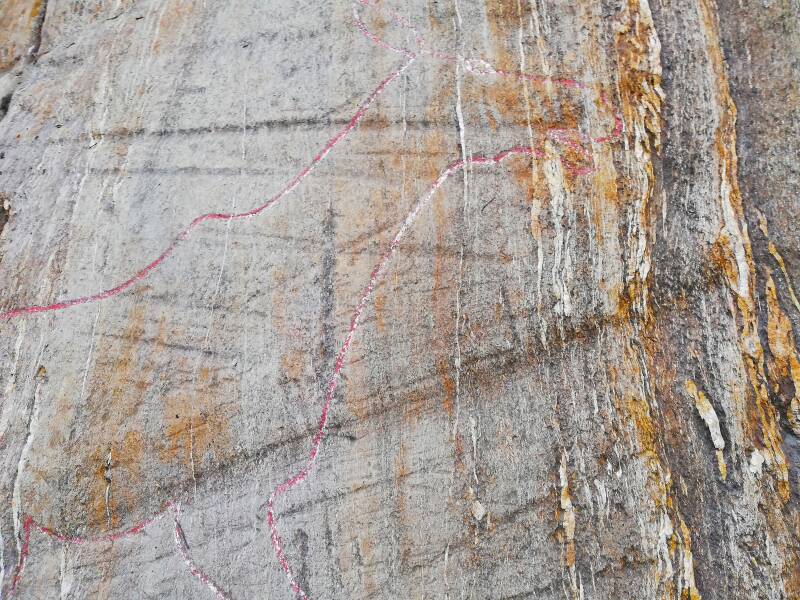
The petroglyph depicts an elk. There may have been some suggestion that it could also be a reindeer, but I think generally, from what I have read, it is considered to be a carving of an elk, which is also painted over, although I do not know how long ago this paint was added, and I think that the original petroglyph was just carved, with the paint added later. Once you see the image of the elk, it is obvious, and clear how large the carving is. But until you get close, it can be quite hard to see, due to the textures in the rock.
The elk carving at Brennholtet could represent many things. But I would imagine that it in some way tells and relates to a story in the landscape regarding the presence of elk there, and human interactions with them. It could be a place honouring the spirit of the elk, and simultaneously a place where elk were hunted, or, where for instance a spiritual hunting ritual or journey associated with elk was conducted.
Photo below: a photo showing the front part of the elk carving on the crag at Brennholtet, the elk's shape, including part of its front leg, head, nose, ears and eye being visible, including its shape more generally. The carving is realistic to how we see, and is not abstract or more akin to a spiritual vision. The fact that the elk has no antlers could indicate that the elk is female, or that it is a male elk which has shed its antlers. If the former, it could pertain to the female elk as representing a kind of mother of the elk, if a male elk having shed its antlers, it could be more indicative of a male elk which has shed its antlers in spring and is wandering alone, in which case would the petroglyph connect to the spirit of a male elk, and to a metaphysical meaning of wandering alone and a kind of spirit journey? Or as I suggest elsewhere in this article, could the carving pertain more to this place being a place connected to the sacred movements of elk - more generally?
The culture who created this carving may well represent the oldest ancestral figures of the peninsula upon which Narvik is situated. What relationship it had to other cultures in Northern Norway at the time, including others which created rock carvings and petroglyphs, is unknown, but for sure the people at Brennholtet 5000 to 6000 years ago likely connect to the those Sámi people who have lived around Narvik into the present time. I do really like Narvik, and this rock carving feels special to me, because it is specific to that place and to the oldest cultures who named the landscape, and who knew its very beginning.
There are likely other sites on the peninsula where Narvik is, between Rombaksfjorden and Beisfjorden. The mountain called Tøttatoppen close to Narvik is very distinctive and beautiful, and I would not be surprised if for example there was an offering site close to it. And on the mountains further towards the Swedish border, there are no doubt other ancient sites, perhaps not yet remembered. There are also some beautiful rock carvings near Skjomenfjord at Forselv, not far from the peninsula upon which Narvik is. Some of the zigzag-like markings on those rock carvings remind me of those at Vitträsk near Espoo in southern Finland, and I wonder if these particular carvings could relate to Finnic speakers, like the Kvens or Lantalaiset in some way, although similar zigzag markings are found in many other places, including Wales and Ireland for instance, and they clearly represent a once widespread form of symbolic language in certain areas. Some of the other carvings at Skjomenfjord are of reindeer, and are generally very similar in style and form to the elk carving at Brennholtet in Narvik, although the zigzag patterns in the box shape near Skjomenfjord, and some of the others, suggest a different influence or usage of a diffing expression of symbolic language. I have also seen it suggested that one of the carvings at Forselv beside the Skjomenfjord may depict a whale, although this does not necessarily suggest that these people were hunting whales, the whale instead may be symbolic of whales in the landscape and their story within it, and the spiritual meanings associated with that truth.
Another interesting example is on the island of Rolla, slightly to the north and in the county of Troms. The carvings at Vik on the island of Rolla seem to depict an elk, some birds, and a couple more “squares” which are akin to those at Forselv near Skjomenfjord, and to those near Vitträsk in Southern Finland. This style of rock carving seems somewhat connected to that of the Lofoten cave paintings, and in a somewhat different sense to the rock carvings at Alta, but seems distinct from both, and locally unique, and may represent a different, but connected ancestral thread of symbolic and spoken language, connected to those other cultural areas and times but not synonymous with all aspects of them. Very recently I also noticed a “square” possible carving at an ancient site in Northern England, and wrote about this and related things on a blog post on a different website very recently.
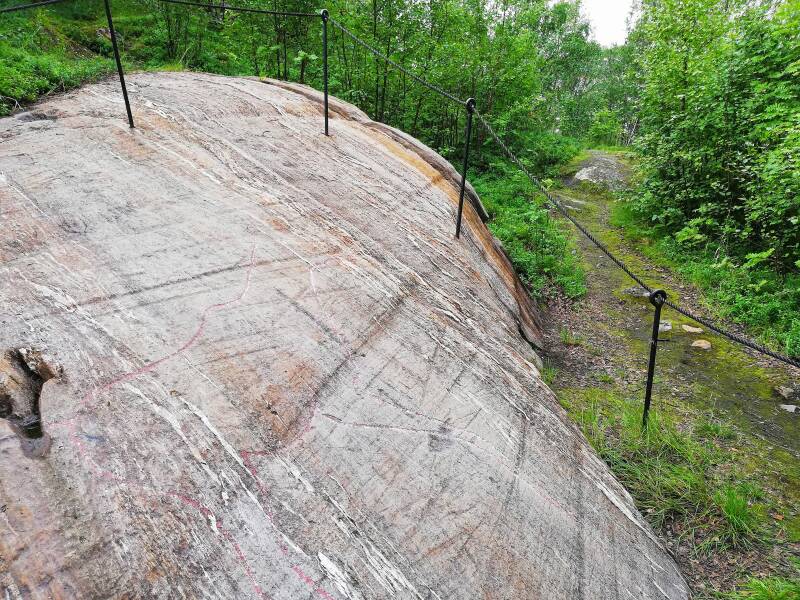
Photo below: a wider angle shot showing the location of the petroglyph at Brennholtet, the full carving with its back leg also visible, is visible on the crag slightly further away from the foreground centre left. When I sat down on the rock at this site, as I mention, I did not of course sit inside the enclosed area, which is enclosed by the cable fence to protect the petroglyph. Note the lsh green woodland surrounding the rock outcrop, I hope it gives a general idea to the very sacred feeling that this site possesses and gives off.
The people who created the carving at Brennholtet may have been coastal, and likely moved by sea to some extent, but there are no depictions of ships or anything like that at Narvik, and perhaps these people instead lived near the coast, but also in the lush coastal valleys and forests, in a landscape, apart from sea level change, which was in many senses similar to that visible today around Narvik. They likely used boats of some kind but perhaps not to the same extent as some other cultural areas in Northern Norway.
The second time I went to the rock carving at Brennholtet, was during the time when I had a relationship break up, and I was distraught. Going to this rock carving at Brennholtet, and sitting there in the warm sun, and listening to the birds and wind in the birch forest, just made me feel as though I had stepped into an ancient safe place, a place where the wind blew, and the birds sung, and the light shone, as it had done when the first ancestral cultures were there. I felt beyond time and connected to something ancient, which did not solve the pain I was feeling, but it did help my soul to breathe, and my spirit remembered the feeling, like a part of me was that place and its spirit, before I was the physical “me” in this life, yet that feeling was also me. To think that the ancestors who made that carving probably sat in a sunny birch forest as I did (not inside the area enclosed to protect the petroglyph), and felt the warmth of the sun, and the breeze from the sea.
Note that I have written much about Narvik elsewhere, including in the first article on this website (published before the article on this page), where I discuss aspects of Narvik, the aforementioned other article being titled: DS1: A new introduction to Northern Sámi; and connected topics, published on the 19/02/2026, the link to which is: https://www.kielimatka-2-11.co.uk/on-the-northern-sami-language-chapters-ds1-to-ds16/ds1-a-new-introduction-to-northern-sami-and-connected-topics-published-on-the-19-02-2026 - note that in the aforementioned article I also discuss Sámi drum symbolic language, which is connected to but a separate topic to the petroglyphs associated with the Sámi.
I have also written about Narvik not long ago in an article on a different website, the article being titled: More on languages around Narvik & more on the Narvik dialect & other topics, published 25/11/2025, the link to which is:
https://www.languages-of-linnunrata.co.uk/more-on-languages-around-narvik-more-on-the-narvik-dialect-other-topics-published-25-11-2025
I hope that this article was an interesting read, it is dedicated to my grandad, and to the Marka Sámi people and to their ancestors who made these petroglyphs. For reference purposes, the URL of this article on this page is: https://www.kielimatka-2-11.co.uk/articles-on-some-other-sacred-archaeological-sites-in-northern-europe-sa1-sa18/sa1-more-about-the-petroglyph-at-brennholtet-in-narvik-published-on-the-01-03-2026
May the gods & the Great Spirit bless us all and watch over and guide us. Note also that the Romance topic in this article, I also refer to another aspect of in a different article recently.