More on Tiree's witches, Tiree Gaelic words & other topics, also publ. 29/06/2026
Written and published by Linden Alexander Pentecost, published on the 29th of June 2026, note that I published an unrelated article connected to Cornish and also to Cornish witches on a different website earlier today. This article on this page is unrelated to and separate from any and all of my other publications, including those many others connected to Tiree which I have published recently in various places. No AI was used in this article nor in any of my written works, this article was published in the UK, and I the author am from the UK and live in the UK, this website is also UK-based. The two photos in this article were also taken by me, on my first trip to the island back in 2023. That rhymes, I'm a poet and I didn't know it. This article contains a total of 2021 words and was completed at 7 pm on the 29th of June 2026.
As I have discussed other examples elsewhere, the folklore of Tiree contains quite a few references to, and tales about witches. The area of Tiree around Kenavara/Ceann A’ Bharra contains much mythology, referring to a Green Lady, mysterious caves, a ciuthach and a witch. This witch legend can be found in part 20 of the book Tiree Tales Sgeulachdan A Tiriodh by Fiona E MacKinnon. The witch referred to in the story in question, like the “Finns” of more Northern mythology, and like the witches of Mull, was able to influence the weather of the sea, and according to this legend, the witch of Kenavara/Ceann A’ Bharra would meet with the witches of Coll and Mull every five years, and on a particular year, the witches of Mull and Coll went to the Kenavara witch's cave on Tiree, at Kenavara, where they had a kind of competition in spell casting, causing lighting and thunder to fill the skies. The Tiree witch became annoyed with the others, and threw two stones after them, one of which landed in Balinoe (The Balinoe Standing stone?), and the other which landed in Caolas in the eastern part of Tiree, and became known as Clach na Gaoithe (Stone of the Wind), although further research has revealed to me that this stone was also known as Clach na Stoirm - “The storm stone”; there being a separate legends about this stone, not the standing stone I have personally visited at Caolas and discussed elsewhere, but rather a different one near a graveyard - legends that if this stone is ever moved then a massive storm or hurricane will sweep Tiree.
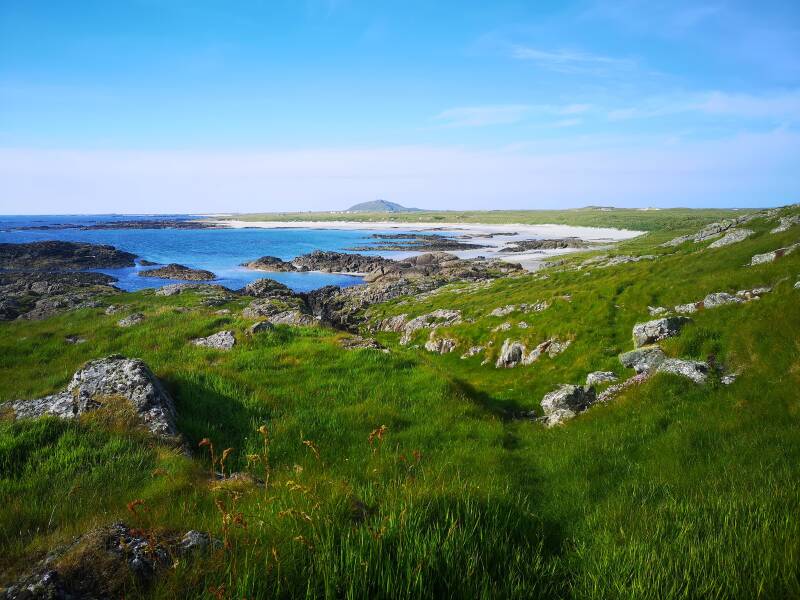
Photo below: a gorgeous landscape looking from near the base of Kenavara/Ceann A' Bharra and across Tràigh nan Gilean towards Sandaig, with the mountain of Beinn Hough in the distance. This area of Tiree around Ceann A' Bharra was clearly one of great spiritual and ancient importance, and I wonder if the word Barra in the sense of a "raised" area out of the sea might be of mythological importance here too. The photo below does justice I think to the immensity of this island's landscapes and spiritual beauty, as seen from the spiritual place of Ceann A' Bharra. Note again that this is another part of Tiree with dangerous "geos" or chasms that appear out of nowhere, so please take extreme care when walking this coastline. Note that I also discuss other aspects of Ceann A' Bharra and nearby Tràigh Bhì in many other publications, including in recent ones, all separate and different from each other.
This can again be seen in context to what I wrote in an unrelated article recently about The Ringing Stone on Tiree and also to what I have written about Clach Mhór nan Gleannan on Barra, although in terms of Clach na Gaoithe, this stone being moved seems to cause a large storm or hurricane, but would not sink the entire island when moved, as would be the case with The Ringing Stone and with Clach Mhór nan Gleannan. It seems that Clach na Gaoithe is now buried by tarmac, but at least the stone is now unlikely to be moved I suppose. This whole theme of standing stones somehow being used to prevent extreme weather and/or energy fluctuations is also a really interesting topic in and of itself, there has been some research also on how some of the dolmens in the Caucasus mountains are constructed near fault lines (I cannot currently remember who this research was by), the general implication being that the dolmens could perhaps have been used in some way for altering the energy and preventing these fault lines from becoming unstable and causing damage. This is at least the idea.
This also seems to be the idea at Clach na Gaoithe, although in this case the story implies that this stone was connected in some way to the energy interactions between the air and the (faultlines and energy lines in the) land, and hence it is perhaps not surprising that the placement of Clach na Gaoithe is associated with lightning and thunder, and why the stone itself is said to prevent hurricanes or strong winds. Note that this is not to imply that this stone was used in a “technological” way but rather in a way that can be considered as “magical” and connected to the holiness of the landscape.
The western side of Tiree contains two large lochs, Loch Bhasapoll in the north and Loch A’ Phuill in the south. Both lochs represent areas which would once have been saline or brackish water lagoons in the past, but since then, Tiree has risen, and the lands between these lochs and the present day coastline have been filled with sand, and dune landscapes have developed.
Loch A’ Phuill can be translated to mean “Loch of Mud” but it is also possible that a’ phuill, from Gaelic poll, here refers to the lagoon-like, silly tidal pool which once stood there, rather than referring to the muddiness of the loch itself. Note that previously I had assumed that the names Loch Bhasapoll and Crossapol on Tiree also referred to “pools” but later learned that these names are more likely connected to the Icelandic word ból - “a dwelling”.
Having said that there is still suggestion I think of the indigenous and possibly ancient use of poll in reference to “pools” on Tiree, which is not found in all of the Hebrides. Loch A’ Phuill is one possible example, whilst Poll Orisgal is a definite example, located on the channel known as An Fhaodhail which runs from the coast to the east of Crossapol and heads roughly north towards western Balephetrish, this channel in past times, even in a not so distant past, could more or less cut Tiree in half during the winter, when the channel often flooded.
Clearly An Fhaodhail also represents the final route of the sea through this part of Tiree from north to south, and the use of a poll name, i.e. Poll Orisgal, in this context, makes perfect sense. Lochs Bhasapoll and A’ Phuill would also likely have connected at one time, forming another large channel through what is now the flat landscapes of this part of western Tiree, but having said this, there is also a Loch A’ Phuill on the Isle of Coll, which is located far above the sea level, and which must more specifically refer to the loch being muddy, so again I am not quite sure about what the poll in the name Loch A’ Phuill is referring to, but a lagoon meaning is still possible I think, given that the nearby village is called Baile A’ Phuill and not for example Baile Loch A’ Phuill.
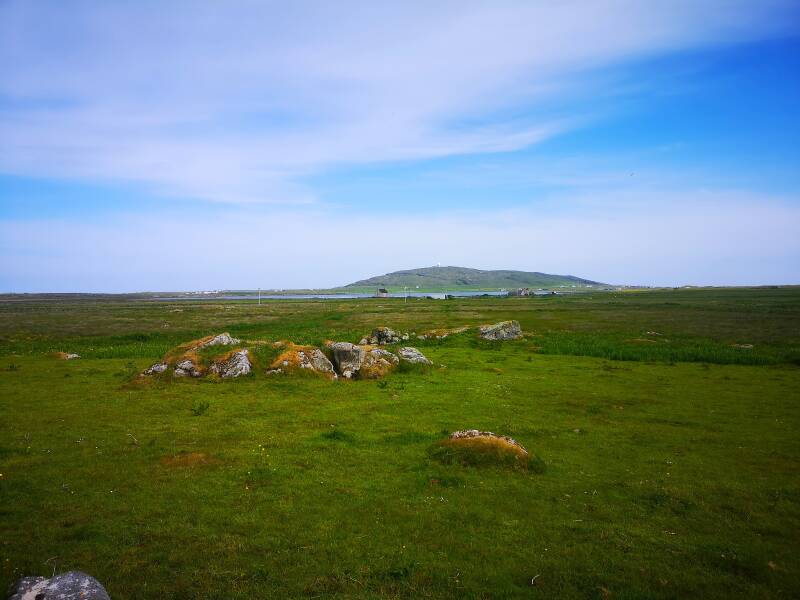
Photo below: a view towards Loch A' Phuill, taken from near Barrapol, also not far from Ceann A' Bhara, the photo below also shows Ben Hynish with Loch A' Phuill visible before it. The land directly in front of where this photo was taken, looks in part to have been reclaimed from Loch A' Phuill, and also according to the legend of the Cailleach Bheur and Loch A' Phuill as described in Tiree Tales - Sgeulachdan a Tiriodh by Fiona E MacKinnon, this Cailleach Bheur was said to have a cottage a cottage at Barrapol, of which a pile of stones is said to be the ruin. I do not know "which" mound or mile of stones around Barrapol this is, but perhaps the pile of stones in question is actually a prehistoric structure. In any case, it will not be located far from the landscape shown in the foreground of the image below, and this landscape shown below is indeed deeply connected with the story of the Cailleach Bheur of Loch A' Phuill. I discuss this legend in more detail below the photo below.
There is a legend (as I discuss other aspects of in the photo description above the photo above) connected to Loch A’ Phuill concerning a witch or specifically a Cailleach Bheur or "toothless hag" who was once said to live there. She was said to have an understanding with the Little Folk and was allowed to draw water from a magic well, but that she had to place the lid onto the well after usage. The water granted her everlasting life, a mythological theme which reminds me of this idea of the “divine food of the gods” etc, also known as “ambrosia”. In the context of witches however, witch folklore has an awful lot of crossovers with vampire folklore, but I do not believe that that is what is being referred to in terms of this Cailleach Bheur of Tiree.
One day, the witch forgot to place the kid over the well and the well flooded over and formed Loch A’ Phuill. I think that this legend could in some way be connected to an ancient memory of this landscape being inundated by the sea, before later rising out of the sea. But how far back in time are we talking of here? Could this be another reference to Tiree's ancient flood, or at least connected to the flood in some way?
Another thing I would like to discuss here is some of the unusual Gaelic vocabulary used on the island of Tiree, although to some extent this vocabulary is also used elsewhere. Below I will discuss three interesting words used in Tiree Gaelic which I have not discussed elsewhere:
1. tais – ”moist” and ”warm”, also found in other dialects with semantic variations, perhaps related to Proto-Uralic *kačV - warmth (2), and to Proto-Afro-Asiatic: *gaĉ- "be wet" (1), found in the Egyptian and Chadic language families.
2. glutadh – refers on Tiree to a filling of sand or earth in a wall cavity, in other areas can refer to devouring or to eating something quickly, in the latter sense linked to Latin gluttio – ”to swallow” and to English ”gluttony”, but the Tiree sense of the word is different, and I wonder if the distinction is an ancient one.
3. gàbart – on Tiree refers to an open boat or barge, in other areas can mean a barge or an unwieldy person, etymology unknown but perhaps connected to Welsh ceubal – ”boat”, Cornish keibal – ”a ferry” Proto-Afro-Asiatic: *kVbVn- "boat or ship" (1), and Egyptian: kbn.t (1) and Central Chadic *kwamb- "boat" (1). The general sense seems to be of a larger sort of boat used for ferrying people or animals.
Note that whilst I use in-text references elsewhere in this article, that the Proto-Afro-Asiatic and other Afro-Asiatic words above marked with (1) were reconstructed by Alexander Militarev and Olga Stolbova, and can be found on the starlingdb.org website. The Proto-Uralic words marked with (2) were reconstructed by Sergei Starostin and can also be viewed on the starlingdb.org website. I hope that this article was an interesting thing to read, it is dedicated to the people of Tiree, both those living there today and to the ancestors and ancestral presences connected to the island.