Yet more on Tiree Gaelic and other dialects, publ. on the 06/07/2026
Written and published by Linden Alexander Pentecost, and published on the 6th of July 2026, this publication is unrelated to and separate from any and all of my other publications, including those many others pertaining to Tiree. The two photos in this article were also taken by myself. The photo descriptions contain some poetic language and comments too. No AI was used in this article nor in any of my written work, and this article was published in the UK and on this UK website, and I the author am from the UK and am a resident of the UK; this article contains 2 photos and 1719 words.
Gaelic dialects vary greatly across Scotland, in this article I want to discuss some more things about the Gaelic dialects of Tiree, and some newly researched features and points about other certain dialects.
Firstly I would like to say how what is referred to as the “slender r” in Gaelic, i.e. an r which comes before or after an i or e, tends to have higher sound variation in the western Hebrides. Take for example the word written in standard Gaelic spelling as muir meaning “sea”. Whilst throughout Scotland there are variations in whether or not the [i] vowel is pronounced, and some variations in the articulation of the slender r, most forms of this word are much the same throughout Scotland, with a few exceptions, one of which is in the Western Hebrides, mainly in the Outer Hebrides but also in Tiree and Coll to some extent, where this “slender r” can frequently become a semivowel, thus the Tiree form of muir can be written as muȷ (1), with the dotless j, ȷ, representing a semivowel close to the English ‘y’ in “yes”.
As is well known, on Lewis, and to some extent in some other Outer Hebrides dialects, this “slender r” becomes a sound close to the “th” in the English word “this”, albeit articulated with the tongue as though to produce more of a palatal r sound, so for example the Lewis forms of this word can be written as müir (1), müið (1) and müð (1). On the Isle of Barra, this slender r sound frequently becomes a sound similar to the Barra Gaelic slender d, which is pronounced similarly to the English “j” in “jug”, but in the case of the Barra slender r, it is again articulated with the tongue in a position as through to produce a slight palatal r, and I would write the Barra forms of this word as muiđ and muđ (1). St Kilda Gaelic on the other hand very frequently has slender l sounds for these slender r sounds, and hence the St Kilda forms of this word can be written as muil (1).
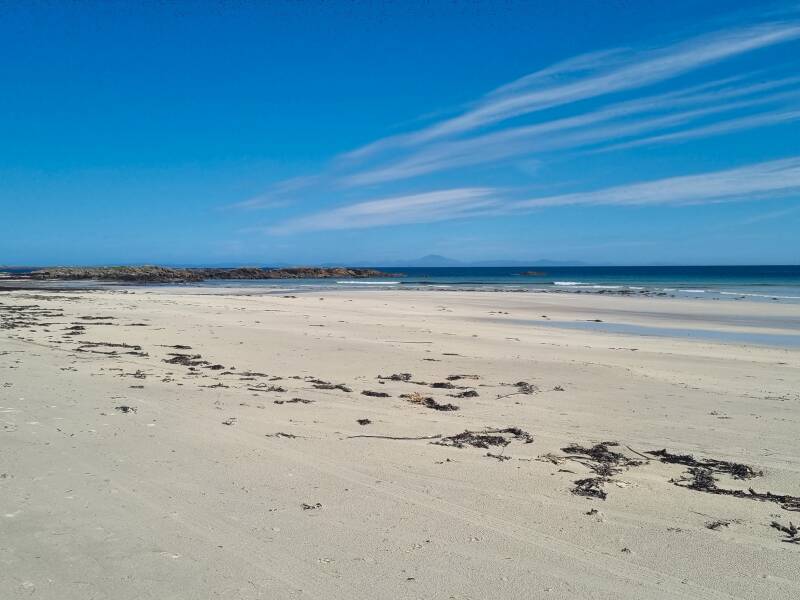
Photo below: a photo of a coastal landscape in Western Tiree, looking towards the mountains of Mull in the distance. At the time I took this photo it was the second to last day of my most recent trip to the island, and I remember feeling sad, and crying as I walked onto this beach from Crossapol and headed towards Balemartine. In some ways, although beautiful, these vast landscapes of Tiree seem to mirror powerful emotions, both sad and happy. They are similar to what in Finnish is known as a "sielumaisema" or "soul landscape", at least for me personally. And to cry in such a landscape is both sad and strangely beautiful. The sands on this beach are also so bright and full of quartz, and this seems invoke feelings in me too, making me think of how sand and quartz are a little like us, stardust, and how the skeletons of the ancients in places like Tiree and Barra when buried in these coastal places also "become" a part of that cosmic sea dust, where the land, sea and sky meet. As mentioned, the sea in this part of Tiree is known as muȷ or as am muȷ - "The Sea", standard Gaelic: "am muir". Note I have published different photos of this beach elsewhere, including in an unrelated blog post in which I also discuss, in different ways, the Tiree word for "giant".
Eriskay, unlike Barra, has a more general slender r sound in this word, and so it can be written as muir (1) in Eriskay. Perhaps in relation to this, the slender d on Eriskay is more commonly a palatal d sound, rather than the English j-like sound on Barra. Essentially, whereas in Argyll mainly, the broad velarised L varies with dental fricative sounds, and d-sounds among others, in the Western Hebrides the slender r varies sometimes with different, but related d-like and dental fricative sounds, and l-sounds among others. It is possible that the underlying variations in these different sounds in both Argyll and the western Hebrides reflect in some way the much more ancient patterns in phonology that might predate Gaelic and Celtic, yet which may pertain to ancient populations, with the Argyll variations with the broad velarised L perhaps representing a separate but connected ancient population to those who vary slender r sounds similarly in the Western Hebrides.
Tiree is particularly interesting here, because linguistically and historically it seems to represent a kind of border area between a larger Central West Lochaber-Mull-Tiree-Coll set of variations whilst also displaying commonalities with the Gaelic of the Outer Hebrides.
I have discussed the Tiree word for “giant” in various places elsewhere, but will discuss it again with more, different information here. In standard Gaelic spelling, the particular general word for “giant” in question is written famhair, but for Tiree Gaelic I write it as foʼɲai̯ʴ (1). We see here another variation of the Tiree slender r, which is [ʴ], and in addition we see an intrusive [ɲ] replacing what is more commonly a hiatus, [h], [f] or [v], or on parts of Lewis an [m]. I was pleased to see this word being used on Tiree in a Gaelic publication, where the word was specifically spelled in Tiree Gaelic and was spelled as foimheir, which is a good way of representing this word using traditional Gaelic orthography, although this spelling, foimheir does not indicate the precise phonology, for those who can’t read my phonetic spelling, this word is pronounced on Tiree as though if you read out the sounds “fon-yeye-r” (“eye” as in how the word “eye”, as in, eyes in the head, is pronounced), with the r sound being a very slight r. Although perhaps a form without the “n” also exists on Tiree - in which case the spelling foimheir would also work; I am not sure though. Tiree also has a fair bit of mythology connected to giants and to giant-like beings, who I believe are connected to the gall for example in Tiree place-names like Dùn nan Gall and thus to certain dun and broch structures, so perhaps this unique intrusive sound in this Tiree form is something “borrowed” from the speech patterns of those ancient people, thought of sometimes, at least metaphorically speaking as being “giants”, although other words are used to describe different groups of variations of these ancestral and otherworldly peoples.
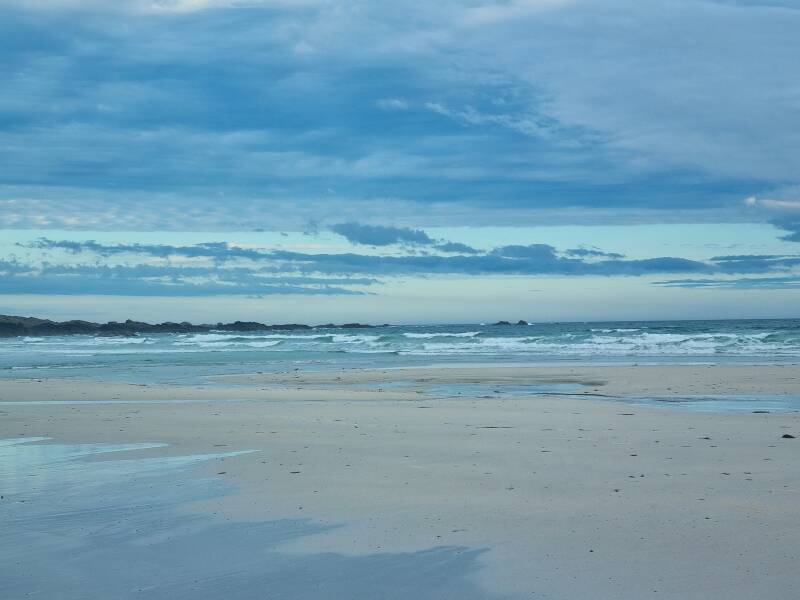
Photo below: another photo (I have published others elsewhere) of Tràigh Bhì in Western Tiree, showing beautiful and mysterious skies with an incredible range of colours. This beach is very close to the historical landscape of some of these "giant" figures in Tiree, as I have discussed elsewhere.
Another curious intrusive sound, I realised recently, occurs in the St Kilda pronunciations of the standard Gaelic spelling màthair - “mother”. On St Kilda, this word could be written as màhail (1), maihail (1), and maiᵑghail (1) respectively, with the latter form being unusual for having both an intrusive [ᵑ], written ᵑ, and an intrusive [ɣ], written as gh. You will also notice how the final slender r in this word has become a slender l. I am noting these particular unusual, intrusive sounds here, but cannot yet say anything about their underlying patterns.
I really know very little about the mythology of St Kilda, nor about what kind of otherworldly cultures and peoples that the “Gaels” as we understand them today encountered there, but I would be extremely curious about looking into this subject. The notion that St Kilda was somehow more “Norse” is utterly ridiculous, and there is no way in Heaven that the unique sound changes of St Kilda Gaelic have anything whatsoever to do with Norse. How dearly I wish that people would stop using the word “Norse” to explain anything about the Hebrides and Gaelic which is not typically Celtic; this solution does not work and has only impeded a more holistic and nuanced, and diverse collective cultural understanding into Scotland’s ancient linguistic and cultural history.
Another thing I would like to discuss here are variations in Gaelic in the western and eastern parts of Tiree, with nearly all of the things I have written about Tiree Gaelic pertaining to that in the west of the island, which, as I have mentioned elsewhere, was sometimes almost entirely “cut off” from the east of the island by flooding, even into quite recent history. So it is perhaps not surprising that the eastern and western sides of the island differ in their treatment of phonemes, although currently I only understand the basics of this and do not understand how this applies across more nuanced words, like foʼɲai̯ʴ/foimheir for example.
One of the primary east-west differences in Tiree Gaelic, is that in the east of the island, the standard written diphthong eu is more likely pronounced as though written ia, at least in certain words, thus standard beul - "mouth" could be written as bial in Eastern Tiree, whilst in Western Tiree this is instead a single vowel, and I would write this word in Western Tiree Gaelic as béal.
I hope that this article was interesting to read; it is dedicated to the people of the Hebrides, ancient and in present times, and to their guardians.
References: All words with a (1) after them were spelled using this orthography I use, partially based upon sounds attested in the Survey of the Gaelic Dialects of Scotland edited by Cathair Ó Dochartaigh.