More about Lismore Gaelic, publ. on the 07/07/2026
Written and published by Linden Alexander Pentecost on the 7th of July 2026, but only properly completed with final updates at 14:14 in the afternoon on the 8th of July 2026. This article is unrelated to and separate from any and all of my other publications, including others pertaining to Lismore Gaelic. No AI was used in this article, this article was published in the UK and I the author am from the UK and live in the UK; the photos in this article were also taken by me and have not been published before; this article contains 3 photos and 1475 words.
I recently, in July 2026, took a trip to the island of Lismore, and so here I will write a little more about the Gaelic dialect of Lismore and about the island’s landscapes. I had never stepped foot on Lismore before, and it did "feel" like a nice island. I saw hardly anyone, but a girl who waved at me from a car as she drove, and a cyclist, obviously not from the island, who I was tempted to ask randomly "excuse me... erm, this is the Isle of Mull isn't it?" to perplex them out of some heyoka-like sense of humour I possess, but I didn't have the chance to in the end. Something about Lismore reminded me a little of Eigg, a similar "vibe" in a sense, even though I do not think that this has any historical basis and comes down merely to my own experience, I guess.
The trees on the island I liked in particular, hawthorns, ashes, many others. Lismore felt much more a part of the Argyll Gaelic world, Barra and Tiree for example for me feel much more orientated towards the maritime cultures of the west, including the later Vikings. Lismore not so much. The views from the island are beautiful too, particularly towards the west and northwest, where mountains rise out of Loch Linnhe, with Lismore itself of course being situated within Loch Linnhe, albeit the outer part of it.
One of the defining features of Lismore Gaelic is that the broad velarised L becomes either [w], [v] or [ʊ], and occasionally other variants, including [f]. Some speakers of Lismore Gaelic seem to use what is more broadly describable as a [w], although the Survey of the Gaelic Dialects of Scotland tends to give [v] and [ʊ] as the most common variants. Some other examples of this [v] in initial position are in the Lismore Gaelic words vong - "ship", vuʊi̯ - "lead", vàidir - "strong", vomadh - "shearing", ván - "full", vɤ̀gh - "calf" and vɤgh - "law". In standard Scottish Gaelic these words are: long, luaidhe, làidir, lomadh, làn, laogh and lagh. Note that in Lismore Gaelic the words vɤ̀gh - "calf" and vɤgh - "law" are distinguished by vowel length. In addition, the slender d in Lismore Gaelic tends to be a palatal d and does not approach the English "j" sound as is common in many other dialects. I have talked about other examples of broad velarised L becoming [v] in Lismore Gaelic in other publications.
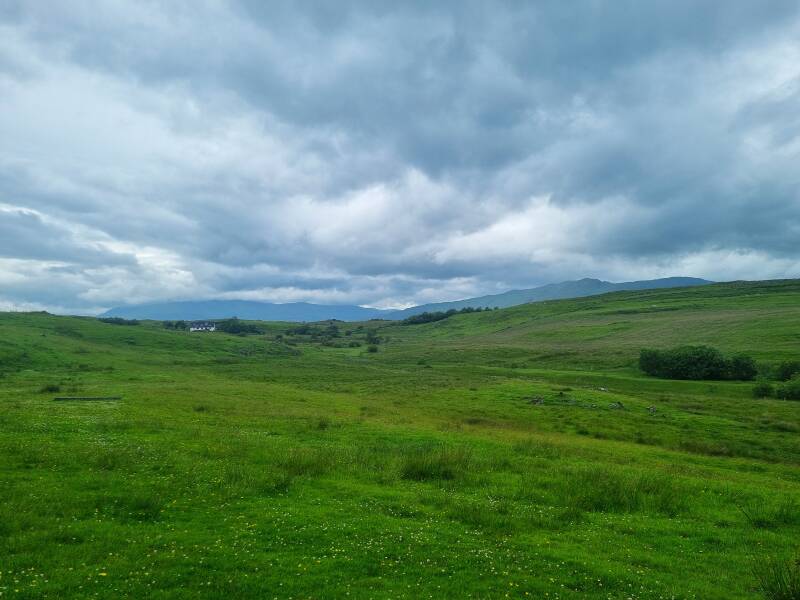
Photo below: dramatic looking July skies ove Lismore, indeed I feel that Lismore is a place of "skies", particularly these kinds of dramatic skies that collect around the coastal sea lochs, which remind me of the skies in July in Norway too.
There are also many examples of the broad velarised L becoming [v] or [ʊ] in medial and final positions can be seen for example in deavag - “thorn”, fuʊv - "sew", favadh - “empty”, eava - “swan”, diuʊ̯tadh - "refusal", dìʊ̯id - "saddle", coʊvadh - "back", eagavais - “church”, ʊrʊbav - "tail" and eʊnvaidh - “birds”, the standard spelling words for which are: dealg, fuaghail, falamh, eala, diùltadh, diallaid, cùlaibh, eaglais, earball and eunlaith. An example of broad velarised L becoming [ʊ] in a medial position can be seen in the word eʊu̯as - “knowledge”, the standard spelling form of which is eolas. In one word at least, the broad velarised L becomes [f], in the word falt - "hair", which in Lismore Gaelic is fafd.
Lismore Gaelic also has a number of other unusual pronunciations, for example standard S. Gaelic deoch - "a drink" does not have a slender d on Lismore and thus can be written as doch. Like in Tiree Gaelic, it can be common in Lismore Gaelic to pronounce two of the same vowels, one after the other, in a sequence and without hiatus, for example standard S. Gaelic cridhe - "heart" becomes crii in Lismore Gaelic, and there are some quite unusual diphthongs as well, with standard S. Gaelic crann - "mast" becoming creʊn in Lismore Gaelic. You will notice that the [ʊ] vowel is common on Lismore and does not by any means always relate to the broad velarised L.
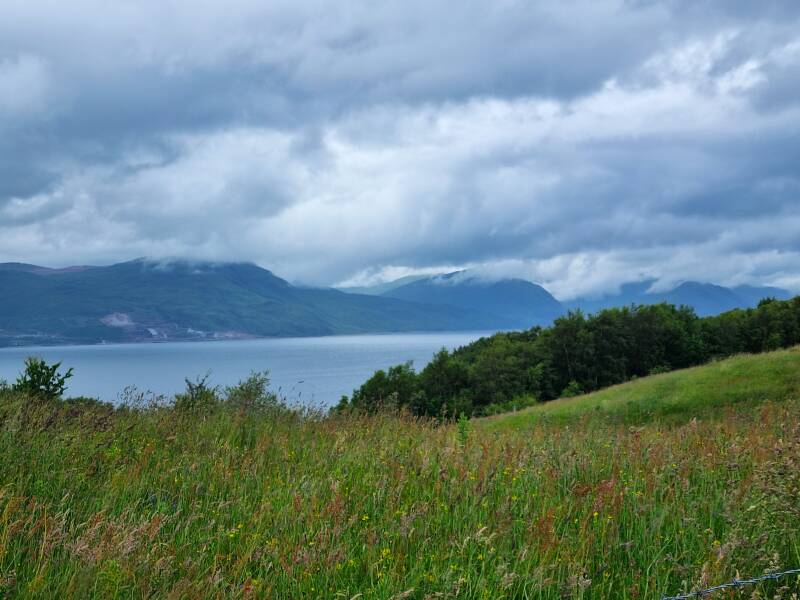
Photo below: looking up the western side of Loch Linnhe, with Lismore in the foreground and to the right, and with the mountains of the West Lochaber mainland visible in the background. Again these skies remind me very much of those in Norway. It's a shame about the presence of a large opencast quarry, visible above the fjord, I mean, sea loch, visible towards the left of this image. Note the grasses and flowers, Lismore, being an island of primarily limestone geology, has quite a different range of wild flowers to some of the other islands.
Whilst there are brochs, duns and numerous cairns on Lismore, I do not know how these structures correspond to the historic, linguistic and folkloric backgrounds of Lismore specifically. The Gaelic dialect here is kind of unusual, not only for its great use of certain sounds, such as [v] replacing the broad velarised L, but also because in many respects Lismore Gaelic can differ from surrounding dialects in its vowels, in certain other consonants, and in that the glottal stop and glottalisation do not seem to be a part of the Lismore Gaelic dialects - at least not according to the Survey of the Gaelic Dialects of Scotland. This automatically seems to put Lismore's dialect into a slightly different historic context, implying, possibly, an early division from other dialects, or a different form of relationship to ancestral cultures in the formation of Gaelic on this island, despite that there are for example brochs and duns on Lismore - none of which I myself had time to visit, as I didn't fancy the prospect of nearly missing yet another ferry or plane from a Scottish island. It's only happened, what, about 3 times so far - once from Barra, once from Eigg, once from Tiree. I'm convinced it has happened far more times than that, but those times were most memorable... and in all fairness I nearly missed the boat to Lismore because I was chatting with someone.
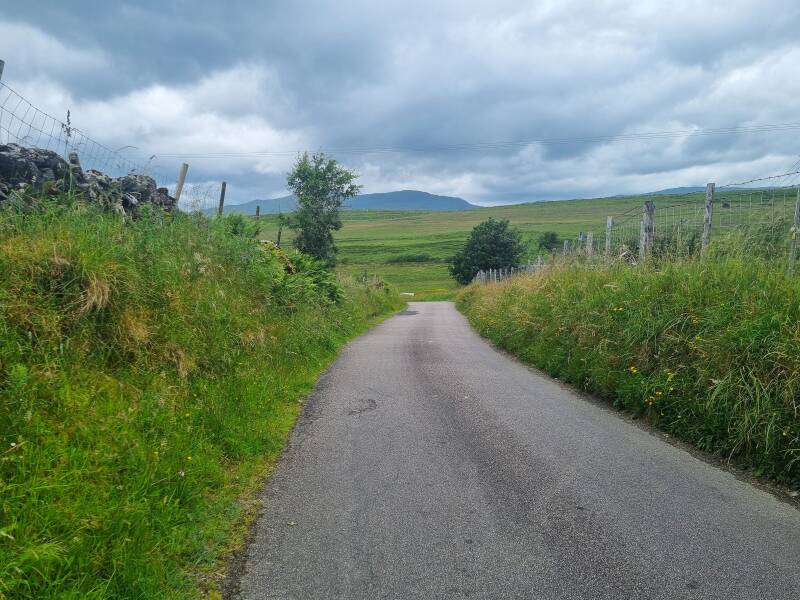
Photo below: one of the roads on Lismore, obviously, with beautiful verges of grass, fern and flower, and with the relatively low but "wavy" landscape of Lismore going off into the distance, with the mountains of the West Lochaber Mainland visible beyond.
In many respects I do think that Lismore Gaelic most closely parallels the Gaelic of the Craignure/southeastern part of the island of Mull, whilst it contrasts greatly with that of southwestern Mull. I talk about this in my quite recently published Silly Linguistics article, titled: More on the unique Gaelic dialects of Mull - and on the origins of Gaelic in the Hebrides & the witches of Mull wherein I also discuss a little on Lismore Gaelic, different to the information published in this article on this page and elsewhere. Lismore Gaelic, as I have mentioned elsewhere, also contains parallels to the Gaelic of St Kilda, although why this is I am not certain. Lismore Gaelic is also in a sense unusual for being spoken on an island quite some way into a fjord or sea loch, whilst still having a unique dialect from surrounding areas. The similarities between Lismore Gaelic and that of southeastern Mull could pertain to ancient population connections between the two areas, although archaeologically speaking, megalithic sites like stone rows and standing stones occur in southeastern Mull, whilst Lismore has a greater number of brochs, duns and cairns, indicating ancient cultural and religious differences - and therefore likely some linguistic differences too.
I hope that this article was a fun read and also - it is dedicated to the people of Lismore, in ancient times and in present times, what a beautiful island indeed Lismore is. Note that all the Lismore Gaelic words in this article marked in bold are spelled in a mixed etymological-phonetic orthography, partially based on how these words in question are phonetically attested in the Survey of the Gaelic dialects of Scotland by Cathair Ó Dochartaigh.